Crypto futures are contracts that let you take a view on a coin’s future price and try to profit from its movement. You don’t need to own the cryptocurrency itself - you’re trading its price.
In 2025, interest in these contracts is rising: more platforms offer them, and traders use them both to protect portfolios and to act on market swings. Below is a clear, concise look at what this instrument is and how to approach it without unnecessary risk.
What are cryptocurrency futures contracts?
A cryptocurrency futures contract is an agreement to settle based on a coin’s price at a future time. You don’t buy the coin itself; you take on exposure that will result in a profit or a loss depending on where the price is at settlement. Exchanges match buyers and sellers with each other, so the market is effectively zero-sum: one side’s gain equals the other side’s loss (after fees and other costs).
Key features:
Price movement exposure. You can take a position for a rise (long) or a fall (short) and try to profit from the move without holding the coins.
Collateral and leverage. To open a position, you post collateral (margin). Leverage lets you control more than your deposit, but it amplifies gains and the risk of forced liquidation.
Contract types. There are fixed-expiry contracts and perpetuals (no expiry). Perpetuals include periodic funding payments between sides to keep the contract price near spot.
Settlement. Most contracts are cash-settled (fiat or stablecoin); physical delivery of the coin is less common.
Costs. Fees are often lower than spot trading; perpetuals also involve periodic funding payments.
Why is it used. Speculation on price moves, hedging existing holdings, and arbitrage strategies - provided you follow clear risk-management rules.
Crypto futures trading fundamentals
An exchange matches the buyer and the seller of each futures contract- the platform itself typically isn’t your counterparty.
If you buy a contract, you profit when its price rises (usually alongside the underlying coin).
If you sell a contract, you profit when its price falls.
A futures market is zero-sum: one side’s gain equals the other side’s loss (after fees and other costs). Contract terms are standardized by the exchange; by placing an order you accept those terms.
What every crypto fut.ures contract includes
Term (expiration) or no expiration: A dated contract closes on a set day; settlement happens according to the exchange’s rules.
A perpetual contract has no end date. A periodic funding payment between longs and shorts helps keep the contract price near spot.Contract size (lot): The amount of the underlying represented by one contract. It can be defined in coin units (e.g., 1 contract = 0.01 BTC) or in notional dollars (e.g., 1 contract = $100 of BTC). Most venues let you trade fractional sizes to right-size your risk.
Leverage (and margin): You post margin (collateral) to open a position and may use leverage to control a notional larger than your deposit.
Example: a 5 BTC position (say $150,000) with 10× leverage might require roughly $15,000 in initial margin. Leverage accelerates both gains and losses, so the exchange enforces a maintenance margin; if your equity falls below it, the position can be liquidated.
How settlement works
Most crypto futures are cash-settled: the losing side pays the winning side the difference in fiat or stablecoin. Physical delivery (actual transfer of the coin) is less common.
Your final PnL comes from the price difference (between entry and exit - or, for dated futures, the final settlement price at expiry), multiplied by contract size, minus fees and any funding paid/received.
Element | What it is | How it works | Why it matters |
Contract type | Dated future or perpetual | Dated futures settle on expiry; perpetuals have no expiry and use periodic funding | Chooses between calendar-based settlement and flexible holding (with a carry cost) |
Term (expiration) | The contract’s end date | On the set date, the position settles by exchange rules (index/spot reference) | Determines when and how results are finalized for dated contracts |
Contract size (lot) | Underlying amount per contract (coin or $) | Fractional trading is typically available | Controls PnL sensitivity to each price move |
Margin & leverage | Collateral you post and the notional multiplier | 10× leverage ⇒ control ~10× your margin; liquidation threshold applies | Drives speed of gains/losses and liquidation risk |
Margin mode | Isolated vs. Cross | Isolated: margin ring-fenced per position; Cross: account equity supports positions | Defines risk boundaries and how losses can spill over |
Settlement | Cash or physical | Most crypto futures use cash settlement; delivery is rarer | Affects operational simplicity and exit flexibility |
Fees & funding | Trading fees and periodic funding (for perps) | Futures fees are often lower than spot; funding can be a cost or income | Meaningfully impacts net results on longer holds |
Mark-to-market | Real-time PnL updates | Equity and available margin track the current price | Gives transparency on risk and liquidation timing |
Type & term set the calendar logic. Perpetuals are flexible, but you must factor in funding.
Contract size is your “scale.” Larger size means a bigger PnL swing per price tick; start with fractional sizes.
Margin & leverage are the core of risk: pre-compute what price move pushes you to maintenance.
Margin mode is a deliberate choice: isolated caps loss on that position; cross can keep it alive longer - by drawing on the rest of your account.
Settlement is usually cash, which is fast and convenient for active trading; delivery is a niche case.
Fees & funding are not small print. Over days or weeks in a perp, they often decide whether a strategy was profitable.
Mark-to-market enforces discipline: you see risk in real time and know when to scale down or exit.
Crypto Futures Account Requirements
To open a futures position, an exchange requires margin - collateral posted in crypto, a stablecoin, or fiat. While the position is open, your result is marked to market in real time. If your equity falls below a set threshold, the exchange may liquidate the position; this is a standard risk-control mechanism.
Before liquidation, platforms often send a margin call - a notice to add funds or reduce size to restore your maintenance margin and avoid forced closure.
Futures contracts are standardized by the exchange, and trades occur between traders. By placing an order, both buyer and seller accept the contract’s common rules (contract size, tick size, settlement, margin, etc.).
Requirement | What it means | Where you see it | Why it matters |
Collateral type | Which asset you use as margin: stablecoin, fiat, or crypto | Contract specs & account settings | Affects PnL conversion and how stable your collateral is vs. volatility |
Initial margin | Minimum deposit to open a position | Shown when you set size/leverage | Sets how much notional you can control |
Maintenance margin | Minimum equity to keep a position open | Displayed as liquidation/maintenance threshold | Determines when a forced close can occur |
Leverage | Ratio of position notional to your margin | “Leverage” field/slider | Speeds up both gains and losses; raises liquidation risk |
Margin mode | Isolated (margin ring-fenced per position) or Cross (shared account collateral) | Chosen at order entry | Defines loss containment for a single position vs. entire account |
Liquidation price | The price at which the system will close the position | Auto-calculated and updates with the market | Lets you estimate the adverse move your trade can withstand |
Fees & funding | Trading fees plus periodic funding for perpetuals | Fee schedule & contract page | Change net returns when you hold positions |
Settlement | Cash-settled or physical delivery | Contract specs (“settlement/currency”) | Governs how results are finalized operationally |
- Start with collateral and leverage: what are you posting, and how much are you amplifying moves?
- Check the liquidation price: can your position survive a typical move for this market?
- Know your margin mode (isolated/cross) and ongoing costs (fees, funding).
Notes on the table:
- In hedges and arbitrage, understand the basis (the gap between spot and futures) and the schedule/level of funding.
- Leverage is useful only when maximum loss and liquidation price are computed up front.
- Skipping asset custody simplifies ops but removes benefits tied to ownership (e.g., staking yield).
The core distinction is exposure. Spot trading gives you direct ownership of the asset in your wallet. Crypto futures give you price exposure without holding or self-custodying the coin itself.
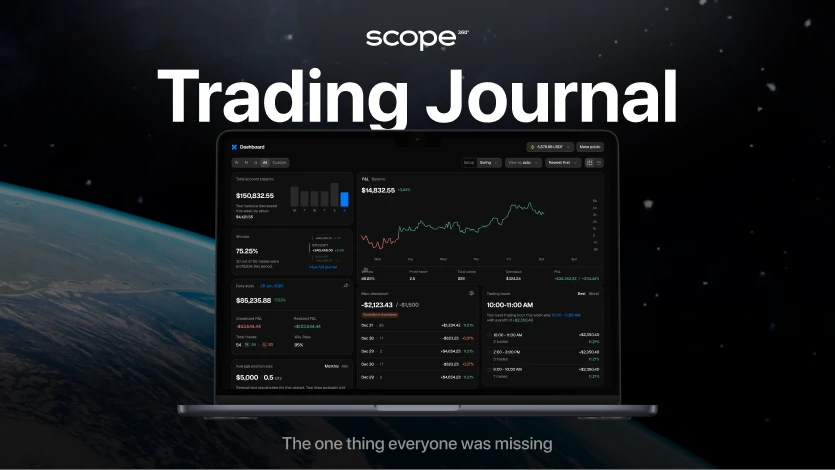
Where exactly Scope helps
Futures trader’s task | What Scope360° does |
Consistent review of every trade | Customizable trade card layout: required fields (notes, files/screenshots, execution history, checklist), preset chart view. System fields are auto-filled; you add only the context. |
Risk and discipline control | Drawdown limits by day/week/month/quarter with a clear status and an indication of the breach point on the main dashboard. |
Honest PnL, not “on paper” | Accounting for fees, slippage, and periodic payments on perpetual contracts - the result is real, not theoretical. |
Comparing setups and conditions | Tags: leverage, margin mode (cross/isolated), funding sign, basis, session/time. They make it easy to filter, build reports, and see patterns. |
Data without manual routine | Secure read-only autosync with exchanges and MT4/MT5: entries flow into the journal automatically - no CSV import or manual data transfer. |
Neat public presentation | Cards for publishing individual trades or a trading day with a choice of fields - convenient for feedback from a mentor or a team. |
A consistent review structure makes trades comparable, tags turn scattered observations into data, and transparent drawdown control sets boundaries for emotions. As a result, decisions become clear and repeatable - for both beginners and experienced traders.