In recent years, a new path has gained popularity in trading - funded trader programs. These are offered by proprietary trading firms that provide traders with access to capital if they can demonstrate consistent, disciplined performance.
For many, it’s an opportunity to build a trading career without needing a large personal deposit. You don’t risk your own money - instead, you take an evaluation, prove you can manage risk and generate results, and then the firm allocates capital to you. A share of the profits becomes yours.
This model comes with both advantages and challenges. Let’s take a closer look at what these programs are, how they work, and how Scope360° can play a role in helping traders succeed.
What is a funded trader
A funded trader is a trader who trades not with their own money, but with capital provided by a special type of company called a prop firm (short for proprietary trading firm).
* What is a prop firm?
A prop firm is a company that gives traders access to its own capital for trading.
The firm risks its money, while the trader follows its rules.
Profits are split between the trader and the firm (often 80/20 or 70/30).
To qualify, the trader must first prove they can trade consistently without taking excessive risks.
In simple terms
A funded trader is someone who doesn’t need to deposit a large amount of their own money but has a strategy and the willingness to trade. If they pass an evaluation (challenge) - by reaching a profit target and staying within drawdown limits - the prop firm allows them to manage its capital.
Why it matters
No risk of losing your own deposit. You don’t have to put up tens of thousands of dollars - the firm provides the funds.
Access to significant capital. Even a trader starting small can get $25k, $50k, or $100k+ accounts.
Discipline and rules. To keep funded status, traders must respect limits and trade systematically.
A funded trader is a trader who has proven their skills and earned the right to trade with a prop firm’s capital. For the firm, it’s a way to profit from skilled traders. For the trader, it’s a chance to work with larger sums without big personal investment.
How funded trader programs work
Funded trader programs are built around a simple idea: prove that you can trade with discipline, and you’ll be trusted with more capital. Here’s how the process usually works, step by step:
1. Choosing a prop firm and a plan
You start by selecting a prop firm and the type of account you want to trade. Each plan comes with:
Account size: the virtual balance you’ll be evaluated on (e.g. $25k, $50k, $100k).
Profit target: the percentage you need to make to pass (often 8–10%).
Drawdown limits: strict rules on how much you can lose in a single day or overall (e.g. max daily loss of 4%, total max drawdown of 10%).
Trading rules: sometimes restrictions on holding trades, trading during major news, or using certain strategies.
2. Evaluation phase (challenge)
This is the main test. You trade on a demo account with real market prices, aiming to hit the profit target without breaking the drawdown rules.
Most firms require you to trade for a minimum number of days.
If you hit the target and stay within the limits, you pass.
If you break the rules (for example, exceed daily drawdown), the evaluation ends, and you may need to restart.
3. Verification (sometimes a second step)
Some firms add a second stage with softer profit targets but the same risk rules. The goal is to confirm that your results weren’t just luck, but consistency.
4. Getting a funded account
Once you pass, you receive a “funded” account. In most cases, this is still a simulated account, but the profits you generate are paid out by the firm according to their rules.
Profit splits are often 70/30, 80/20, or even higher.
Payouts are scheduled weekly, bi-weekly, or monthly, depending on the firm.
5. Scaling up
If you keep trading profitably and within the rules, many prop firms increase your account size. For example, a $50k account may grow to $100k, then $200k as you hit milestones. This is called a scaling plan.
6. Losing funded status
If you break the risk rules - like exceeding the maximum drawdown - the funded account is closed. You can usually try again, but it means paying for another challenge or reset.
In a nutshell: you pay for participation → prove your skills on a demo account → receive a funded account → share profits with the company → increase your limit if you perform consistently.
Benefits of funded trader programs
Why have funded trader programs become so popular? Because they solve the biggest problem most traders face - a lack of starting capital. But that’s not the only advantage.
1. Access to large capital without personal funds
For a beginner, it’s difficult to raise a trading deposit of tens of thousands of dollars. In a funded program, the firm provides the capital. You don’t risk your own money - you only pay for the evaluation. This gives a real opportunity to those who can trade but don’t have the resources to start big.
2. A fair skill check
The evaluation challenge acts as a filter. To earn a funded account, you must show profit and respect risk limits. It’s an objective test: does your strategy really work, and can you manage losses? Many traders discover their weak points for the first time during the evaluation stage.
3. Discipline development
Funded programs force you to trade systematically. Random trades or emotional decisions won’t work here - any rule violation means losing the account. This pushes traders to build good habits: recording trades, journaling, and planning risk properly.
4. Scaling potential
With consistent performance, your account size can grow. For example, starting with $25k, you may move up to $100k or even $200k as long as you stay profitable and follow the rules. This gives you a chance to scale much faster than if you only traded your own funds.
5. Career entry point
A funded program can serve as a career starting point. Many traders use it to prove their skills and build a track record. It’s not just “demo trading” - there’s real motivation to stay disciplined and aim for payouts.
6. Extra benefits
Some prop firms provide education, mentorship, or access to private trader communities. For beginners, this is valuable: you’re not only taking the challenge but also entering an environment that supports faster growth.
In short: funded trader programs offer a chance to start trading seriously without big upfront costs, help you build discipline, give you scaling opportunities, and turn trading into a structured process.
Risks and Misconceptions of Funded Trader Programs
1) “Live money” vs. simulation
In most funded programs, trading after the evaluation is carried out on demo infrastructure: the “funded account” is a simulated environment with payouts based on the firm’s rules, not direct access to live brokerage capital. For example, FTMO explicitly states that it provides demo accounts with simulated funds; trading is done in a simulated environment. Critics also highlight that some firms use synthetic price feeds that may differ from broker execution.
What it means for traders: execution details (slippage, liquidity, swap rates) may not fully match your broker’s experience. This doesn’t make the model “fake,” but you should be realistic about how transferable your results are.
2) Strict risk rules - the #1 reason traders fail
The firm’s top priority is risk control, so the rules are very strict: daily drawdown, max overall drawdown, minimum trading days, restrictions on holding over weekends/news. Example: FTMO’s daily loss limit on a $200k account is $10k (5%); exceeding this triggers instant disqualification.
Takeaway: in a challenge, the goal is not only to hit the profit target but, more importantly - not to break the rules. Always plan daily and per-trade risk in advance.
3) Paid challenges and resets
Participation is paid (one-time fee or subscription). The Funded Trader, for instance, clearly states you must pay an upfront fee for the demo evaluation; after passing, payouts are simulated according to firm rules. If you break the rules and lose the account, you usually need to pay for a reset or a new challenge - and these costs can add up.
Takeaway: calculate the economics in advance: entry fees, the likelihood of resets, and the expected payouts.
4) Regulatory uncertainty
Prop firms are not brokers, and many operate outside strict financial regulation. Reviews note, for example, that some firms are not FCA-regulated in the UK (The Funded Trader mentioned by GMG).The legal landscape is shifting: high-profile cases such as MyForexFunds in the U.S. show that regulators are closely scrutinizing the industry. Court rulings have even challenged CFTC’s sanctions in this context, proving how fluid regulation can be.
Takeaway: always check the jurisdiction, payout terms, and legal status of the firm before paying for a challenge.
5) Payout conditions and hidden thresholds
Payout structures vary widely: schedule (weekly/bi-weekly/monthly), minimum profit thresholds, transfer fees, and the trader’s profit split. At FTMO, for instance, traders can receive up to 80–90% of simulated profits, with payouts every 14 days and certain minimum withdrawal amounts. The Funded Trader has separate rules for payouts and scaling depending on the type of challenge.
Takeaway: always read the Payouts/Withdrawals and Fees sections. Compare not just the advertised “profit split” but the actual payout conditions.
6) Strategy restrictions and trading conditions
Some firms restrict certain strategies: news trading, high-frequency scalping, arbitrage, or copy trading. For example, City Traders Imperium explicitly lists rules for news trading and EAs (allowed under certain conditions).
Takeaway: make sure your trading method (scalping, bots, arbitrage) is allowed. Even if profitable, breaking strategy rules can get your account terminated.
7) The “easy money” myth
Marketing often highlights quick payouts and “scaling up to $1M,” but the reality is sustainability: small consistent profits, minimal mistakes, and zero rule violations. Even the firms themselves emphasize that the goal is stable discipline, not “one lucky trade.”
Takeaway: treat this as a marathon, not a sprint. Keep a trading journal, track your risk, and monitor your behavior - that’s the real “secret” to passing.
8) Program differences between firms
Even within a single firm, plans differ: account sizes, drawdown rules, profit splits, minimum trading days. FTMO, for instance, provides detailed allocation limits and account parameters in its documentation.
Takeaway: don’t assume one prop firm’s rules apply everywhere. Create a “rulebook” for the exact program you sign up for.
9) Psychological pressure
Even if the account is simulated, the fear of losing funded status (due to strict risk limits) adds stress. Many traders start “chasing the target,” raising risk, and breaking discipline - the most common reason for failing evaluations. Prop firms themselves highlight in their educational material how crucial it is to respect these triggers in advance.
Quick checklist before paying for a challenge
Do I understand that the account is simulated and payouts follow firm rules?
Do I know the exact risk limits and “red lines”?
Have I read payout rules, fees, and minimum thresholds?
Is my strategy allowed under firm rules?
Have I checked the firm’s reputation and regulatory standing? (The MyForexFunds case proves how quickly the legal environment can shift).
How Scope360° Helps Funded Traders
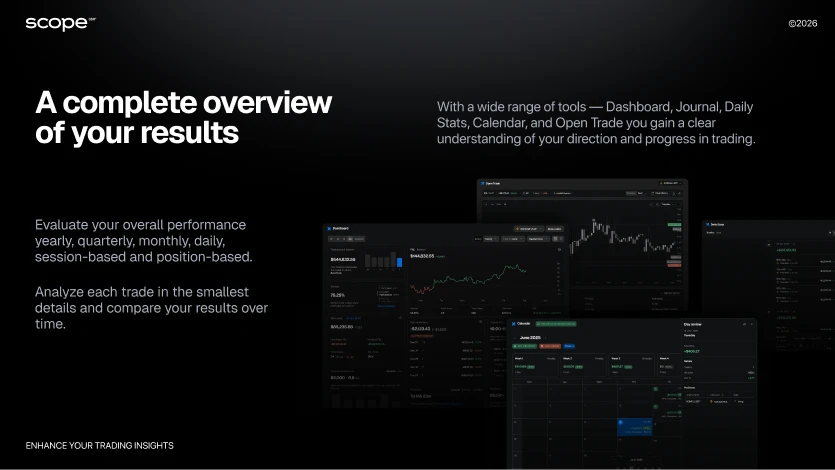
Passing a funded challenge is not only about “making profit” - it’s about discipline and staying within risk limits. This is where Scope360° comes in: it turns your trade history into clear analytics and helps you stay compliant with prop firm rules.
1. Automatic trade import
Connect via API or upload a CSV.
All trades are automatically synced into your journal.
No more manual spreadsheets.
2. Structured journal with tags and notes
Every trade becomes a “card” with:
instrument, date, size, and result;
strategy and setup tags;
notes explaining why you entered or exited;
optional screenshots.
This way, you track not just results, but also the reasoning behind each trade.
3. Key metrics for funded programs
Scope360° automatically calculates dozens of metrics. The most important for funded challenges include:
4. Real-time risk control
Metric | Why it matters in a challenge |
PnL | Tracks overall profit/loss performance |
Win rate | Measures consistency of profitable trades |
Risk/Reward | Ensures trades justify the risk taken |
Max / Daily Drawdown | Aligns with firm’s strict risk limits |
Average trade duration | Checks whether you follow your own strategy |
Consistency | Proves steady results rather than one lucky trade |
Scope360° shows daily and overall drawdowns so you can compare them against firm rules. This helps you avoid breaking limits - the most common reason traders lose funded status.
5. Behavioral analysis
Scope360° identifies patterns that often cost traders their accounts:
overtrading,
exiting winners too early,
holding losing trades too long,
emotional revenge trades.
By spotting these behaviors, you can correct them before they break your challenge.
6. Use it at every stage
Before the challenge: import past trades, tag strategies, and see which setups are consistent vs. unprofitable.
During the challenge: track daily drawdowns and PnL, log mistakes, and adjust.
After getting funded: monitor stats and scale only the setups that truly work.