
You’ve seen the success stories online. You’ve downloaded a trading app. You’re ready to buy and sell stocks, crypto, or futures within the same day to capture quick profits.
But then you hear the rumors. "Isn't day trading illegal?" - "Don't you need a special license?" - "What if the SEC freezes my account?"
If you are asking, "Is day trading legal?", the short answer is yes. Day trading is perfectly legal in the US, UK, Europe, and most major global markets. It is a legitimate profession and a recognized trading style.
However, while the act is legal, the environment is heavily regulated.
There is a web of rules - like the infamous Pattern Day Trader (PDT) rule in the US, margin requirements, and strict laws against market manipulation - that determines how you can trade. Cross these lines, and you could face account freezes, fines, or bans.
In this guide, we will cut through the legalese and explain exactly what you are allowed to do, what gets you flagged, and how to keep your trading business on the right side of the law.
Is Day Trading Legal in General?
Let’s be crystal clear: Buying and selling a financial asset on the same day is legal.
Whether you are trading stocks, options, futures, or cryptocurrency, no law prohibits you from entering and exiting a position in minutes or hours.
Legality depends less on speed and more on method and compliance.
Legal: Analyzing charts, reading news, and executing rapid trades based on public information.
Illegal: Using non-public "insider" information, coordinating with others to artificially pump prices, or using automated tools to "spoof" the market (placing fake orders to deceive others).
As long as you are using your own capital (or funded capital you are authorized to use) and trading on public information through a regulated broker, you are in the clear.
U.S. Day Trading Rules: The Pattern Day Trader (PDT)
If you are trading stocks or options in the US, the biggest regulatory hurdle isn't the government - it's FINRA (Financial Industry Regulatory Authority) and their Pattern Day Trader rule. This is the rule that confuses beginners the most.
What Is the Pattern Day Trader (PDT) Rule?
Under FINRA rules, you are flagged as a "Pattern Day Trader" if you execute 4 or more "day trades" within a rolling 5-business-day period in a margin account, provided those trades represent more than 6% of your total trading activity for that period.
A "day trade" is defined as opening and closing the same position (same ticker) during the same trading session.
The $25,000 Requirement
If you are flagged as a PDT, you must maintain a minimum equity of $25,000 in your account.
If you have $25k+: You can day trade as much as you want (up to your day trading buying power).
If you drop below $25k: You will be issued a "day trading call." If you cannot deposit funds to get back above $25k, your broker will restrict your account to "closing only" or ban you from day trading for 90 days.
What’s Changing (2025–2026 Outlook)
The regulatory landscape is shifting. FINRA and the SEC have proposed amendments to modernize these rules. While the $25,000 rule remains the standard for now, regulators are moving toward a risk-based margin system.
This means in the near future, your ability to day trade might depend less on a flat $25k balance and more on the actual risk of your portfolio. However, until these rules are fully implemented by all brokers, assume the $25k limit stands.
Margin vs. Cash Accounts: The Loophole?
Many traders ask: "Can I avoid the PDT rule by using a cash account?"
Yes. The PDT rule applies only to margin accounts. In a cash account, you can day trade with less than $25,000.
The Catch: You are subject to Cash Settlement Rules.
In a cash account, you can only trade with settled funds.
If you buy a stock and sell it, those funds must "settle" (typically T+1 or T+2 days) before you can use them again.
If you trade with unsettled funds, you trigger a "Good Faith Violation" or "Free-Riding Violation," which can get your account restricted.
Illegal Practices: Where Traders Cross the Line
While day trading is legal, certain behaviors are strict felonies or civil offenses.
1. Insider Trading
You cannot trade based on material, non-public information.
Example: Your friend works at TechCorp and tells you they are failing their earnings report tomorrow. You short the stock today. Illegal.
2. Market Manipulation
You cannot artificially influence the price of an asset.
Pump and Dump: Buying a cheap stock, spreading false rumors online to hype it up, and selling into the rally.
Spoofing: Placing massive buy orders with no intention of filling them, just to make the market look bullish and trick others into buying.
3. Wash Sales (Tax Avoidance)
This isn't "illegal" in the sense that you go to jail, but it violates tax codes. A Wash Sale occurs if you sell a security at a loss and buy a "substantially identical" one within 30 days. The IRS disallows that loss deduction. Day traders generate huge volumes of wash sales, complicating taxes significantly.
Day Trading Rules Outside the US
If you are trading outside the United States, the rules are often different (and usually more relaxed regarding account minimums).
United Kingdom (FCA)
There is no PDT rule. You can day trade with £500 if you want.
The focus is on Leverage Caps. For retail traders, leverage on CFDs (Contracts for Difference) is restricted (e.g., 30:1 for major forex pairs, 2:1 for crypto) to protect traders from blowing up accounts too fast.
European Union (ESMA)
Similar to the UK, there is no $25k minimum equity requirement.
ESMA strictly regulates leverage limits and requires brokers to offer Negative Balance Protection (you cannot lose more than you deposited).
How a Proper Journal Helps You Stay Compliant
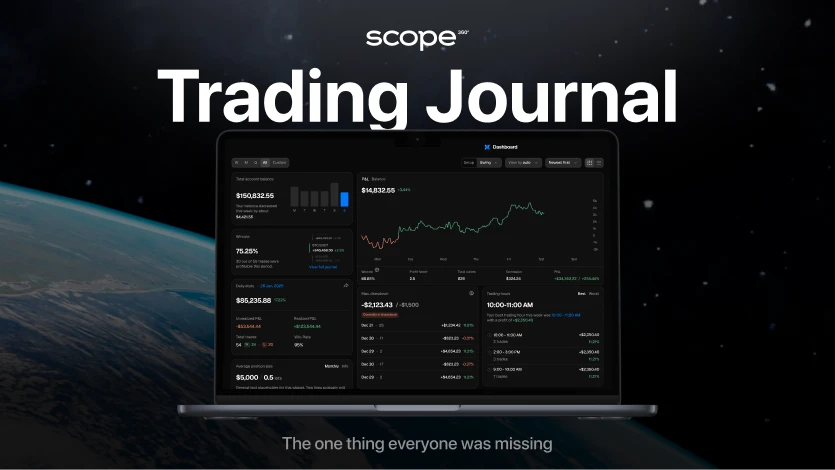
Compliance isn't just about avoiding fines; it's about running a professional business. This is where a tool like Scope360° becomes your safety net.
Most beginners track trades to see profit. Pros track trades to see risk and compliance.
1. Avoid Accidental PDT Triggers
If you are in a small margin account, you need to know exactly how many day trades you have used in the last 5 days. Scope360°’s automated import logs every timestamp, helping you visualize your frequency so you don't accidentally trigger the 90-day freeze.
2. Proof of Conduct
If a broker ever flags your account for "suspicious activity" (e.g., you made huge profits during a volatility spike), having a detailed journal with your trade rationale, setup tags, and notes proves that your trades were based on strategy, not manipulation or insider info.
3. Tax & Wash Sale Tracking
By automatically syncing all your trades via API, Scope360° creates a permanent, unalterable record of your buy/sell history. This is invaluable when tax season arrives and you need to calculate your cost basis and wash sales accurately.
Practical Checklist: How to Day Trade Legally
Before you place your next trade, ensure you check these boxes:
Know Your Account Type: Are you Margin or Cash?
Check Your Equity: If Margin (US), do you have $25k? If not, limit yourself to 3 day trades per 5 days.
Understand Settlement: If Cash, are you waiting for T+1 settlement before reusing funds?
Source Information Legally: Are you trading on public charts and news, or rumors from "insiders"?
Track Everything: Use an automated journal to maintain a clear audit trail.
Conclusion
Is day trading legal? Yes.
Is it a free-for-all where you can do whatever you want? No.
Day trading is a regulated profession. The rules - PDT, margin limits, wash sales - are guardrails designed to keep the market fair and prevent systemic risk.
If you ignore them, you risk frozen funds and restricted accounts. If you respect them, you build a sustainable business.
Don't let a regulatory technicality ruin your trading career. Treat your trading like a business from Day 1.
Ready to professionalize your process?
Sign up for Scope360° today to automate your trade tracking, monitor your performance, and keep a perfect audit trail of every position you take.
FAQ
Is day trading legal in the US?
Yes, day trading is legal in the US. However, it is regulated by FINRA. If you trade stocks in a margin account with less than $25,000, you are limited to 3 day trades in a rolling 5-day period (the PDT rule).
What is the Pattern Day Trader (PDT) rule?
The PDT rule states that if you execute 4 or more day trades within 5 business days in a margin account, you must maintain a minimum account balance of $25,000. If you drop below this, you cannot day trade until you deposit more funds.
Can I day trade with less than $25,000?
Yes. You can use a Cash Account (where PDT does not apply, but you must wait for funds to settle) or trade assets that are not subject to PDT, such as Futures or Forex.
Is day trading crypto legal?
Yes, day trading cryptocurrency is legal in most jurisdictions, including the US and EU. Crypto markets run 24/7 and are generally not subject to the PDT $25k rule, though individual exchanges may have their own policies.
Can you go to jail for day trading?
You cannot go to jail for day trading legally. However, you can face criminal charges for illegal trading activities such as insider trading, market manipulation, or tax evasion.