Every professional athlete practices before the big game. Every pilot spends hundreds of hours in a flight simulator before carrying passengers. Yet, millions of aspiring traders open a brokerage account, deposit their hard-earned savings, and start trading immediately without a single hour of practice.
The result? Financial disaster.
Paper Trading is the solution to this problem. It is the bridge between studying a strategy and risking real capital. It allows you to interact with the live market, feel the pace of price action, and test your theories - all without the risk of losing a single dollar.
In this guide, we will cover everything you need to know about paper trading: how it works, why it is critical for your success, the hidden dangers of "demo confidence," and how to transition to a live account using advanced analytics tools like Scope360°.
What Exactly Is Paper Trading?
Paper trading (often called Demo Trading or Simulated Trading) is the act of buying and selling assets in a simulated environment that mirrors real market conditions.
The term comes from the pre-digital era, where aspiring traders would literally write down their buy and sell prices on a piece of paper to track how they would have performed. Today, paper trading is done on sophisticated software that looks and feels exactly like a real trading terminal.
How It Works in 2026
Modern paper trading platforms connect to live data feeds. When you see Bitcoin trading at $95,400 on a demo account, it is trading at $95,400 in the real market.
The Balance: You start with virtual funds (e.g., $10,000 or $100,000 of "Monopoly money").
The Execution: When you click "Buy," the software simulates an order fill at the current market price.
The PnL (Profit and Loss): Your account balance grows or shrinks based on your decisions, but no real money changes hands.
Paper Trading vs. Backtesting: What’s the Difference?
Many beginners confuse these two concepts. Both are essential, but they serve different purposes.
Feature | Backtesting | Paper Trading (Forward Testing) |
Time | Past. Testing a strategy on historical data (e.g., 2023-2025). | Present. Testing a strategy in real-time as the market moves. |
Speed | Fast. You can simulate years of trading in minutes. | Slow. You must wait for the market to move. |
Psychology | None. You know the outcome instantly. | Moderate. You have to wait and manage patience. |
Purpose | To see if a strategy has potential. | To see if you can execute the strategy. |
Takeaway: Backtesting proves the strategy. Paper trading proves the trader.
Why Every Trader Must Start with Paper Trading
Skipping the paper trading phase is the most expensive mistake you can make. Here are three reasons why you must spend time in the simulator.
1. Mastering the Mechanics (Fat Finger Errors)
Trading platforms can be complex. There are Limit orders, Market orders, Stop-Losses, Trailing Stops, and OCO (One-Cancels-the-Other) orders. Imagine trying to short Bitcoin during a crash, but you accidentally click "Buy" because you confused the buttons. In a real account, that mistake could cost you thousands of dollars. On a paper account, it costs you nothing but pride. Paper trading builds muscle memory. You learn to calculate position size and execute orders without thinking.
2. Validating Your Strategy in Current Conditions
Markets change. A strategy that worked in the bull market of 2024 might fail in the chopping market of 2026. Paper trading allows you to "forward test" your system in the current market environment to ensure it still has an edge.
3. Building Routine and Discipline
Trading is a lifestyle. It requires waking up at specific times, analyzing news, and sitting through boring periods of low volatility. Paper trading allows you to test if this lifestyle actually suits you before you quit your job or commit significant capital.
The Dangerous Trap: "Demo Millionaire Syndrome"
While paper trading is a powerful tool, it has a dark side. It can create a false sense of security known as "Demo Confidence."
If you double your money on a demo account, does it mean you will double your money on a live account? Absolutely not. Here is why paper trading is deceptively easy compared to the real thing.
1. The Psychology of Loss
This is the biggest difference. When you lose $500 of virtual money, you might feel a slight annoyance. When you lose $500 of your rent money, your heart races, your palms sweat, and your brain enters "fight or flight" mode. Real trading involves Fear and Greed. Paper trading does not. Many traders who are calm snipers on demo become panic-sellers on live accounts.
2. Unrealistic Liquidity and Fills
In a simulation, your orders are usually filled instantly at the price you see.
Demo: You sell 10 BTC at $95,000. Filled instantly.
Live: You try to sell 10 BTC. The market might slip to $94,950 before your order is filled (Slippage), or there might not be enough buyers (Liquidity issues). Paper trading often ignores slippage and trading fees, making your strategy look more profitable than it actually is.
3. The "Reset Button" Mentality
If you blow up your demo account, you just hit "Reset" and start over. In real life, there is no reset button. This lack of consequence can train you to take reckless risks that you would never take with real cash.
How to Paper Trade Correctly (Best Practices)
To make your practice sessions valuable, you must make the simulation as realistic as possible. Follow these golden rules.
Rule 1: Use a Realistic Balance
If you plan to deposit $2,000 into your real trading account, do not open a demo account with $100,000. Trading with a large account hides mistakes. A $500 loss on a $100k account is 0.5% (negligible). A $500 loss on a $2k account is 25% (catastrophic). Action: Adjust your demo balance to match your planned live capital exactly.
Rule 2: Account for Fees and Commission
Most basic simulators do not deduct trading fees. In high-frequency trading (scalping), fees can eat up 30% of your profit. You must mentally (or manually) account for these costs.
Rule 3: Treat It Like Real Money
This requires imagination. Before every trade, ask yourself: "If this were real money from my bank account, would I still take this trade?" If the answer is no, don't click the button.
A 4-Week Paper Trading Training Plan
Don't just trade randomly. Follow this structured curriculum to graduate from "Novice" to "Ready for Live."
Week 1: Platform Mastery & Mechanics
Goal: Learn the software.
Task: Execute every type of order (Limit, Market, Stop-Limit). Try shorting and longing. Purposefully make mistakes to see what happens.
Metric: Zero execution errors by Friday.
Week 2: Strategy Testing
Goal: Find one setup that works.
Task: Pick ONE strategy (e.g., Breakout or Moving Average Crossover). Trade only that strategy. Do not deviate.
Metric: Execute 20 trades following the exact rules of the strategy.
Week 3: Risk Management Focus
Goal: Protect capital.
Task: Set a strict risk rule (e.g., lose max 1% per trade). Calculate your position size for every single trade.
Metric: No single loss should exceed your 1% limit.
Week 4: The Profitability Exam
Goal: Simulate live conditions.
Task: Trade your strategy with full focus. Treat every loss as painful.
Metric: End the week in profit (Green PnL) with a Win Rate > 40%.
The Missing Link - Analytics & Journaling
This is the most critical section of this guide. Most traders fail the transition from Demo to Live because they don't track their data. They just look at the final balance.
"I made $500 this week, I'm ready!"
But how did you make it? Did you make 10 good trades? Or did you make one lucky reckless gamble that paid off?
Without analytics, you are flying blind.
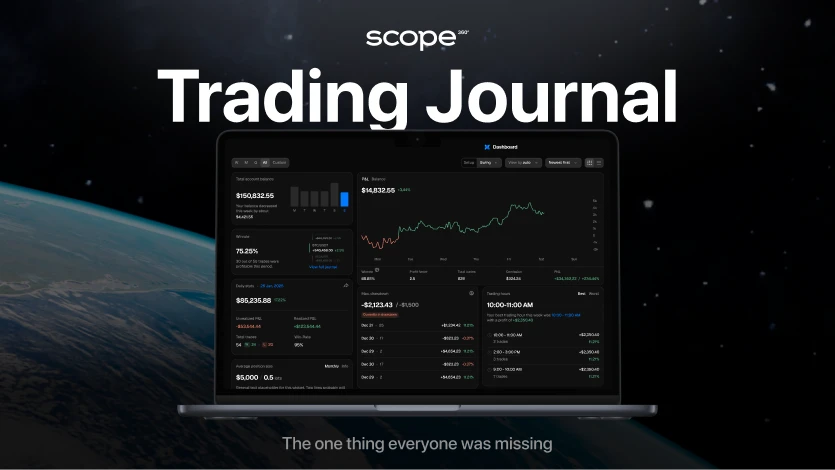
Why You Need Scope360 During Paper Trading
You should start using a professional trading journal like Scope360 during your paper trading phase, not after.
Scope360 allows you to:
Identify True Skill: It filters out luck. If your "Profit Factor" is below 1.5, you are not ready for live trading, even if you made money.
Spot Behavioral Leaks: Do you over-trade on Fridays? Do you lose money when you trade Ethereum but win when you trade Bitcoin? Scope360 visualizes these patterns.
Calculate Realistic Expectations: By tracking your demo trades, you will know your "Expected Value" per trade. This gives you confidence when you switch to real money.
Manually input your paper trades into Scope360 or connect your platform's testnet API. Seeing your equity curve grow smoothly is the best confidence booster.
When to Go Live? (The Checklist)
How do you know when you are ready to graduate? Use this checklist. If you cannot check all the boxes, stay on the simulator.
I have paper traded for at least 4 consecutive weeks.
I have been profitable for the last 2 weeks.
I have strictly followed my risk management rules (no losses > 2%).
I have experienced a "losing streak" and did not tilt or break my rules.
I have journaled my trades in Scope360 and understand my Win Rate and Profit Factor.
I am comfortable with the trading platform interface.
Conclusion
Paper trading is the safest place to fail. And make no mistake—you will fail. You will make bad calls, you will miscalculate leverage, and you will miss trends. It is infinitely better to make these mistakes with virtual currency than with your life savings.
However, paper trading is not a game. It is a training ground. The seriousness with which you treat your paper trading will determine your success in the live markets.
Don't rush the process. The market will be here forever. Take your time, build your data, and refine your edge.
Ready to track your progress? Whether you are on a demo account or a live account, you need to know your numbers. Sign up for Scope360 today and turn your practice data into professional insights.
Disclaimer: The information provided in this article is for educational purposes only. Paper trading results are hypothetical and do not represent actual trading. Virtual performance does not guarantee future results in a live trading environment. Trading financial markets involves risk.