Many beginners look at a trading chart and see chaos. Professional traders see a story.
Technical Analysis (TA) is the art of reading market sentiment through price data. It is not a crystal ball that predicts the future; it is a framework for identifying probabilities.
In this guide, we will strip away the noise and focus on what really matters: Price Action.
1. The Language of Price: Japanese Candlesticks
Before you can write, you must learn the alphabet. In trading, the alphabet is the Japanese Candlestick. Unlike a simple line chart, a candlestick tells you four key pieces of information about a specific time period:
Open: The price when the period started.
Close: The price when the period ended.
High: The highest price reached.
Low: The lowest price reached.
The Story Behind the Candle
Every candle tells a battle story between Buyers (Bulls) and Sellers (Bears).
Component | What it Represents | Psychology |
Green (Bullish) Body | Close > Open | Buyers won. They pushed the price up by the end of the session. |
Red (Bearish) Body | Close < Open | Sellers won. They pushed the price down. |
Long Wick (Shadow) | Price was rejected | Rejection. If there is a long wick on top, buyers tried to push up, but sellers slapped them back down. |
Small Body (Doji) | Open $\approx$ Close | Indecision. Neither buyers nor sellers have control. A big move is often coming. |
Pro Tip: Don't just memorize patterns like "Hammer" or "Shooting Star." Understand the logic: A long wick indicates a failure to maintain a price. That failure is your signal.
2. Market Structure: Support and Resistance
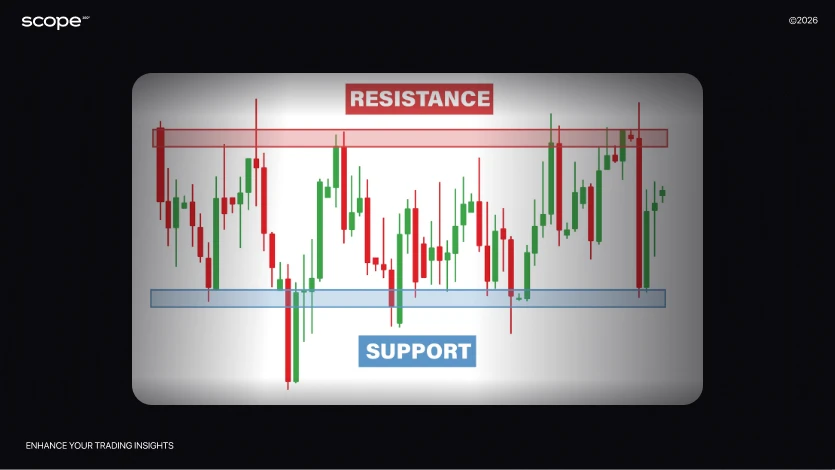
If candlesticks are the bricks, Market Structure is the blueprint of the house. Prices do not move in straight lines. They move in waves, creating levels where price tends to stop and reverse.
Support (The Floor)
Support is a price level where buying interest is strong enough to overcome selling pressure. Think of it as a floor that prevents the price from falling further.
Why it forms: Buyers see this price as "cheap" and step in. Short sellers take profits (buy back), adding to the buying pressure.
Resistance (The Ceiling)
Resistance is a price level where selling pressure overcomes buying pressure. It is a ceiling that caps the price rise.
Why it forms: Traders see the price as "expensive" and sell. Buyers who bought at the bottom are now taking profits.
The "Polarity Flip" Concept
This is a key concept for intermediate traders. Once a Resistance level is broken, it often becomes Support (and vice versa).
Scenario: Price smashes through a $50,000 ceiling.
Retest: Price comes back down to $50,000.
Flip: The old ceiling becomes the new floor. This is a classic "Break and Retest" entry strategy.
"The trend is your friend until the end." - Ed Seykota. Identifying whether the market is making Higher Highs (Uptrend) or Lower Lows (Downtrend) is more important than any fancy indicator.
3. Indicators: Friends or Foes?
New traders often make the mistake of adding 10 indicators to their chart until they can’t even see the price candles. This is called "Analysis Paralysis."
Professional traders follow the K.I.S.S. Rule (Keep It Simple, Stupid). Here are the three most essential tools used by pros.
1. Volume (The Fuel)
Volume is the only leading indicator. It shows how much money is behind a price move.
Price goes UP + Volume goes UP: Strong trend (Healthy).
Price goes UP + Volume goes DOWN: Weak trend (Reversal likely).
Rule of Thumb: A breakout of a Resistance level without high volume is likely a "Fakeout" (False Breakout). Don't trust the move unless the volume confirms it.
2. Moving Averages (The Trend)
Moving Averages (MA) smooth out price action to show the general direction.
SMA 200 (Simple Moving Average): The long-term trend line. If price is above the 200 SMA, the market is generally Bullish. If below, it is Bearish.
EMA (Exponential Moving Average): Reacts faster to recent prices. Traders often use the 9 EMA or 21 EMA for short-term entries.
3. RSI (The Speedometer)
The Relative Strength Index (RSI) measures the speed of price changes. It ranges from 0 to 100.
Above 70: Overbought (Price might be too expensive $\rightarrow$ Potential sell).
Below 30: Oversold (Price might be too cheap $\rightarrow$ Potential buy).
Indicator | Purpose | Best Use Case |
Volume | Validation | Confirming if a breakout is real. |
Moving Averages | Trend Direction | Determining if you should be looking for Longs or Shorts. |
RSI | Momentum | Finding entry points on pullbacks. |
4. The Reality Check: Probabilities, Not Predictions
Here is the hard truth: Technical Analysis does not work 100% of the time.
You can have a perfect "Double Bottom" pattern, a bullish hammer candle, and oversold RSI - and the price can still crash.
Why? Because TA is a game of probabilities, not certainties.
A good setup might have a 60% chance of working. That means 4 out of 10 times, you will lose.
How to Turn Probability into Profit
If you cannot predict the future, how do you make money? By knowing your stats.
This is where Scope360.io becomes your edge.
Instead of blindly trusting a chart pattern, you use Scope360 to track your actual performance with that pattern.
Scenario: You notice you keep losing money on "Breakout" trades.
The Scope360 Insight: You check your automated journal and see:
Win Rate on Breakouts: 35% (Losing strategy).
Win Rate on Pullbacks: 65% (Winning strategy).
The Action: You stop trading breakouts and focus only on pullbacks.
You stop gambling and start optimizing.
Conclusion
Technical Analysis is a language. It allows you to read the market's intent. But knowing the language isn't enough - you need to track your conversations.
Master the basics: Candlesticks, Support/Resistance, and Volume.
Ignore the noise: Don't clutter your charts with too many indicators.
Track the data: Use Scope360° to measure which patterns actually make you money.
Ready to see what works? Don't just draw lines on a chart. Track the results.Connect your account to Scope360.io and let the data guide your trading.