Imagine being able to test your trading ideas and strategies before risking any real money. That’s the power of backtesting. By using historical data, backtesting allows traders to analyze the potential profitability and risks of their strategies, helping them make informed decisions and improve their overall trading performance.
However, many traders are intimidated by the complexity and technical details associated with this tool, which prevents them from fully leveraging its benefits. That’s why we created this detailed guide - to demystify the backtesting process and make it accessible for traders of all levels. So, what exactly is backtesting?
What is Backtesting?
Backtesting is a method used in finance and trading to evaluate the effectiveness of a trading strategy or investment approach by applying it to historical market data. It involves simulating trades and assessing the results of a strategy as if it had been implemented in the past. Essentially, it enables traders to validate their ideas and theories against real market conditions to understand how those strategies would have performed.
To perform backtesting, traders typically define a set of rules and parameters that describe their trading strategy- such as entry and exit signals, risk management rules, position sizing, and other important factors. These rules are then systematically applied to historical market data to create a simulated trading history.
It’s important to note that while backtesting can provide valuable insights, it is based on assumptions and historical data. Market conditions and dynamics may change, and past performance does not guarantee future results. Therefore, it should be used as a complementary tool alongside other forms of analysis and risk management.
How Does Backtesting Work?
Conducting backtesting requires a reliable database and a clear understanding of the strategy you want to implement. It also requires suitable software or a website that supports backtesting.
Historically, before specialized tools simplified and optimized calculations, effective backtesting was mostly accessible to programmers. While backtesting tools have become more available, challenges remain that hinder its widespread adoption.
These challenges primarily stem from the factors used in backtesting. For instance, using a reliable database is crucial to minimize errors, as discrepancies can lead to very inaccurate results.
Additionally, attention should be paid to the amount of data rows used in testing. Modeling large volumes can be time-consuming, while using too little data may fail to accurately reflect market reality.
To address this, simulators typically process data to ensure sufficient volume, optimizing both testing duration and result accuracy.
Why is Backtesting Important for Traders?
Backtesting is vital for traders as it enables them to evaluate the effectiveness and potential profitability of their trading strategies before applying them live. By simulating historical market conditions and applying their strategy to past data, traders can see how it would have performed.
For example, a trader might develop a new strategy based on technical indicators like moving averages and the relative strength index (RSI). They believe this strategy could generate stable profits in trending markets but want to validate it before risking capital.
Using backtesting, traders can apply their strategy to historical market data and analyze outcomes. They can study performance in various market conditions, including trending and ranging markets, and assess profitability, drawdowns (loss periods), and risk-adjusted returns.
If backtesting results show that the strategy consistently generates profits and aligns with the trader’s goals, it builds confidence to use it in real trading. Conversely, if flaws or inconsistencies appear, the trader can modify or abandon the strategy, avoiding potential losses.
Advantages and Disadvantages
Advantages | Disadvantages |
Iterative Testing: Enables multiple tests of your strategy before real market exposure. You can refine your approach based on results, identifying weaknesses and improving your chances of success. | Historical Data Dependency: Based on past results, which don’t guarantee future performance. Markets are dynamic and ever-changing, making it difficult to predict how historical success translates forward. |
Emotion-free Decisions: Helps prevent impulsive, emotional trading decisions like fear and greed that cloud judgment. Testing on historical data removes real money pressure, allowing objective strategy evaluation without emotional bias. | Outdated Data: Testing on old data, sometimes years old, can lead to misleading results as market conditions evolve. Recent data is recommended for relevant and realistic assessments. |
Scenario Analysis: Allows strategy evaluation in different market scenarios, highlighting strengths and weaknesses across conditions. | Subjectivity and Economic Factors: Backtesting cannot include all unpredictable market or economic events. It should be supplemented with ongoing market analysis. |
Increased Confidence: Successful backtesting boosts trader confidence, enabling adherence to plans during volatile times and reducing impulsive moves. | Technical Knowledge Required: Running effective backtests may require programming skills or access to user-friendly platforms, posing a challenge for some traders. Getting expert assistance can help but may introduce dependencies. |
Types of Backtesting
Manual Backtesting: In manual backtesting, a trader reviews historical price charts and applies their strategy by hand, marking entries and exits and recording the results. This approach can be time-consuming, but it helps you develop a deeper intuition for how your strategy reacts under different market conditions. It’s like detective work - moving through price action candle by candle and annotating on a spreadsheet or directly on the chart.
Automated Backtesting: Here, specialized platforms or software (such as MetaTrader, TradingView, or Scope360) execute your strategy’s rules as an algorithm, processing trades automatically across historical data. Automated backtesting is faster, more objective, and less prone to human bias. It also makes it easier to test multiple strategies or make quick parameter adjustments.
Algorithmic Backtesting: This approach requires programming skills: you write code for your strategy (commonly in Python, R, or platform-specific languages) and run simulations on historical data sets. While it takes more technical know-how, it provides maximum flexibility and the ability to analyze vast datasets with precise customization.
Step-by-Step: How to Run a Backtest
Step | Description |
1 | Clearly define your strategy’s entry and exit rules. |
2 | Gather high-quality historical market data. |
3 | Choose a backtesting tool or platform (like Scope360 or another suitable one). |
4 | Set the parameters: timeframes, position size, and account for commissions/slippage. |
5 | Run the test and log each simulated trade. |
6 | Analyze the outcomes (profit, loss, risk metrics, maximum drawdown). |
7 | Compare with other strategies and optimize as needed. |
What to Focus On When Analyzing Results
Percentage of winning trades
Average gain and loss per trade
Maximum drawdown (largest capital drop during the test)
Total net profit or loss over the period
Risk-reward ratio
Common Backtesting Mistakes
Ignoring commissions and slippage: This will distort your real results.
Overfitting: Tweaking your strategy so it looks perfect on past data, but fails in live trading.
Insufficient data length: Testing on too little historical data yields results with little statistical meaning.
Neglecting changing market regimes: Strategies should be tested in a variety of market conditions to ensure robustness.
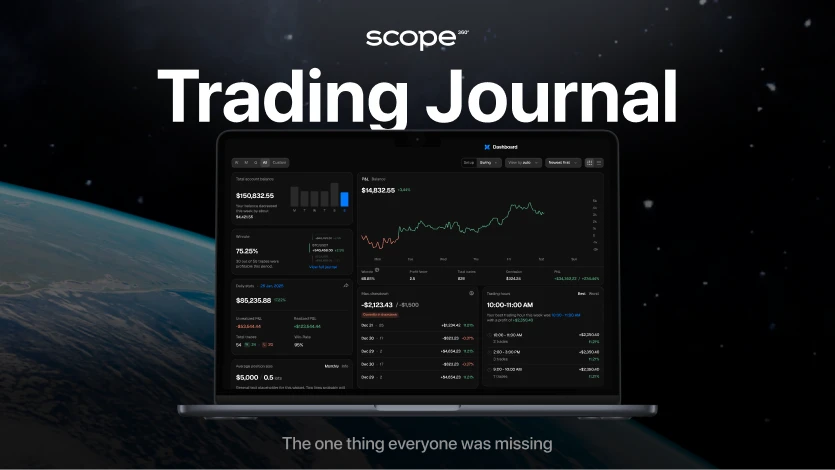
Why Scope360 Makes Backtesting Easier
Simple and fast data import and management
Automation saves time and reduces manual errors
In-depth analytics with clear tables and visual reports
Easy sharing of results with your trading community and access to expert feedback
Using a streamlined platform like Scope360 takes away many of the technical barriers, allowing you to focus on what matters: finding a strategy that works.
Conclusion
Backtesting is a way to check how realistic your strategy is without risking real capital. A good test immediately reveals weaknesses or confirms that a trading idea is worth pursuing. This experience helps you avoid accidental losses and gives you confidence in the real market.
It's better to test thoroughly once and be confident than to wonder later where you went wrong. Want to save yourself time and stress? Try out your ideas with Scope360° — everything is transparent and convenient here.