In trading, there are many strategies, but two of the most popular are day trading and swing trading. Both approaches are widely used in traditional markets (stocks, forex, futures) as well as in cryptocurrency trading.
Day trading is active trading within a single day, where positions are opened and closed during the day.Swing trading is a calmer style, where trades are held for several days or even weeks in order to capture larger market moves.
Why is it important to understand these approaches?
They require different amounts of time, psychology, and discipline.
Risks and potential profits differ significantly.
Choosing the right style directly affects a trader’s performance.
In this article, we will explain what day and swing trading are, compare their strengths and weaknesses, look at the risks behind each approach, and most importantly — show how Scope360° helps traders of any style analyze their trades, manage risks, and trade consciously.
What is Day Trading
Day trading, also known as intraday trading, is a trading style where positions are opened and closed within the same trading day. The goal of a day trader is to profit from short-term price movements, with trades lasting from one hour to one and a half hours.
How day traders operate
They use short timeframes for analysis - most often 15-minute to 1-hour charts.
Focus is critical: traders must watch price action in real time and make quick decisions.
For this reason, day trading is rarely suitable for those who want to trade part-time — it requires high involvement and discipline.
Markets for day trading
Day traders typically focus on markets with high liquidity and large trading volumes, which allow fast entry and exit. Common instruments include:
stocks,
indices,
forex pairs,
cryptocurrencies,
commodities (e.g., gold, oil).
The forex market is particularly popular as it is the largest and most liquid market in the world, with an average daily trading volume of about $6.6 trillion.
Trading instruments used
Day trading is often done with derivative products such as:
CFDs (Contracts for Difference) - allow traders to profit from price changes without owning the asset, capturing the difference between entry and exit prices;
Spread betting (in countries where it is allowed) - a form of trading where profit or loss depends on how far the market moves in the chosen direction.
Both instruments allow traders to go long or short and use margin and leverage, meaning they can control larger positions with relatively small capital. However, leverage increases both potential profits and potential losses.
Types of analysis applied
Technical analysis: indicators (moving averages, MACD), candlestick patterns, chart formations.
Fundamental analysis: economic calendar events (inflation reports, central bank announcements, macroeconomic data) that can strongly impact prices.
Advantages of day trading
No overnight risk (gaps or unexpected events while markets are closed).
Potential for frequent small profits throughout the day.
Many trading opportunities within each session.
Flexibility - the ability to trade both rising and falling markets.
Leverage allows larger exposure with smaller deposits.
Disadvantages of day trading
Time-intensive requires monitoring markets almost all day.
Stress and emotional strain due to fast decision-making.
Higher costs - commissions and spreads add up with many trades.
Greater risk when using leverage.
Risk of overtrading or revenge trading driven by emotions.
Day trading is a dynamic but demanding style, best suited for traders willing to dedicate significant time, handle stress, and maintain strict risk control.
What is Swing Trading
Swing trading is a trading style where positions are held for several days to several weeks. The main goal is to capture larger price movements (known as “swings”) within a medium-term trend. Unlike day trading, where trades last minutes or hours, swing traders are prepared to wait days or weeks for the market to move in their favor.
Key characteristics of swing trading
Medium-term horizon. Trades may last from 2–3 days up to several weeks.
Slower pace. No need to stay glued to the screen all day.
Higher timeframes. Swing traders typically use 4-hour, daily, or even weekly charts.
Mixed analysis. They combine technical tools (support/resistance levels, chart patterns, indicators) with fundamental factors (news, macroeconomic events, company earnings).
Popular markets for swing trading
Swing traders often choose markets where trends are easier to spot:
stocks and ETFs,
forex,
cryptocurrencies,
commodities (oil, gold, silver).
Advantages of swing trading
Time flexibility. No need for constant monitoring - positions can be checked a few times a day.
Larger moves. Potential to capture more profit from a single trend.
Fewer trades. Lower trading costs compared to day trading.
Good for part-time traders. Suitable for those combining trading with a regular job.
Disadvantages of swing trading
Overnight risks. Holding trades overnight or over the weekend exposes traders to gaps and sudden moves.
Swaps and holding costs. Long-term positions may incur rollover fees.
Fewer opportunities. Unlike day trading, setups appear less frequently and may require waiting.
Emotional strain of waiting. Patience is needed to hold positions and avoid exiting too early.
Swing trading is a calmer, more strategic trading style. It suits traders who cannot watch the market all day but are willing to wait longer to ride bigger trends.
Day Trading vs Swing Trading
Both styles are valid approaches to trading, but they differ greatly in pace, requirements, and risks.
Criteria | Day Trading (intraday trading) | Swing Trading (medium-term trading) |
Holding period | From an hour to a whole day | From several days to weeks |
Number of trades | Many trades per day | Fewer trades, held longer |
Timeframes | 1–15 minutes, 1 hour | 4-hour, daily, weekly |
Activity level | High - constant monitoring required | Moderate - positions checked a few times a day |
Main markets | Forex, crypto, highly liquid stocks | Stocks, ETFs, crypto, commodities, trending assets |
Best for | Traders who can dedicate the whole day and handle stress | Traders who combine trading with other work and prefer a calmer pace |
Main risks | Emotional pressure, overtrading, leverage | Overnight risks, gaps, swap/rollover fees |
Profit potential | Frequent small gains with high involvement | Potentially larger profits with patience |
Costs | High commissions from frequent trading | Lower commissions, but holding costs may apply |
How to choose your style
Choosing between day trading and swing trading isn’t about which is “better” - it’s about which one fits your lifestyle, psychology, and goals. Here are the key questions to ask yourself:
How much time can you dedicate to trading?
➝ If you can spend several hours a day in front of the screen, tracking every market move, then day trading may fit you. It rewards speed and focus. ➝ If you have a full-time job, studies, or simply prefer not to stare at charts all day, swing trading offers more flexibility — you can check the market a few times a day without losing control.
What’s your psychology and tolerance for stress?
➝ Day trading is fast-paced. You’ll need to make decisions in seconds and stay calm when volatility spikes. If quick thinking under pressure excites you - this style could work. ➝ Swing trading requires patience. You might hold a trade for
Main Risks of Day Trading and Swing Trading
Both approaches can be profitable, but each comes with its own vulnerabilities. Knowing them in advance helps you prepare and avoid common traps.
Risks of Day Trading
Emotional burnout.
➝ Constantly watching charts and making quick decisions all day can lead to fatigue and costly mistakes.
Overtrading.
➝ The urge to “make back losses” often pushes traders into unnecessary trades, which usually deepens the loss.
High costs.
➝ Frequent trades mean more commissions and spreads. In some cases, costs eat up a large share of profits.
Leverage.
➝ While leverage can magnify profits, it can just as quickly magnify losses.
Risks of Swing Trading
Overnight risks.
➝ Positions are held overnight or over weekends. Unexpected news or gaps can move the market sharply against you.
Swap and rollover fees.
➝ The longer you hold a trade, the more holding costs accumulate.
Waiting and psychology.
➝ Swing traders need patience. Many trades spend time in drawdown before moving in your favor, and that can be emotionally challenging.
Fewer opportunities.
➝ Sometimes you may wait several days for a good setup. This can be hard for impatient traders.
Tip: whichever style you choose, your main shield is risk management. Always use stop-losses, define risk per trade (e.g., 1–2% of capital), and keep a trading journal. This way you can learn from mistakes and keep control of the process.
How Scope360° Helps Swing and Day Traders
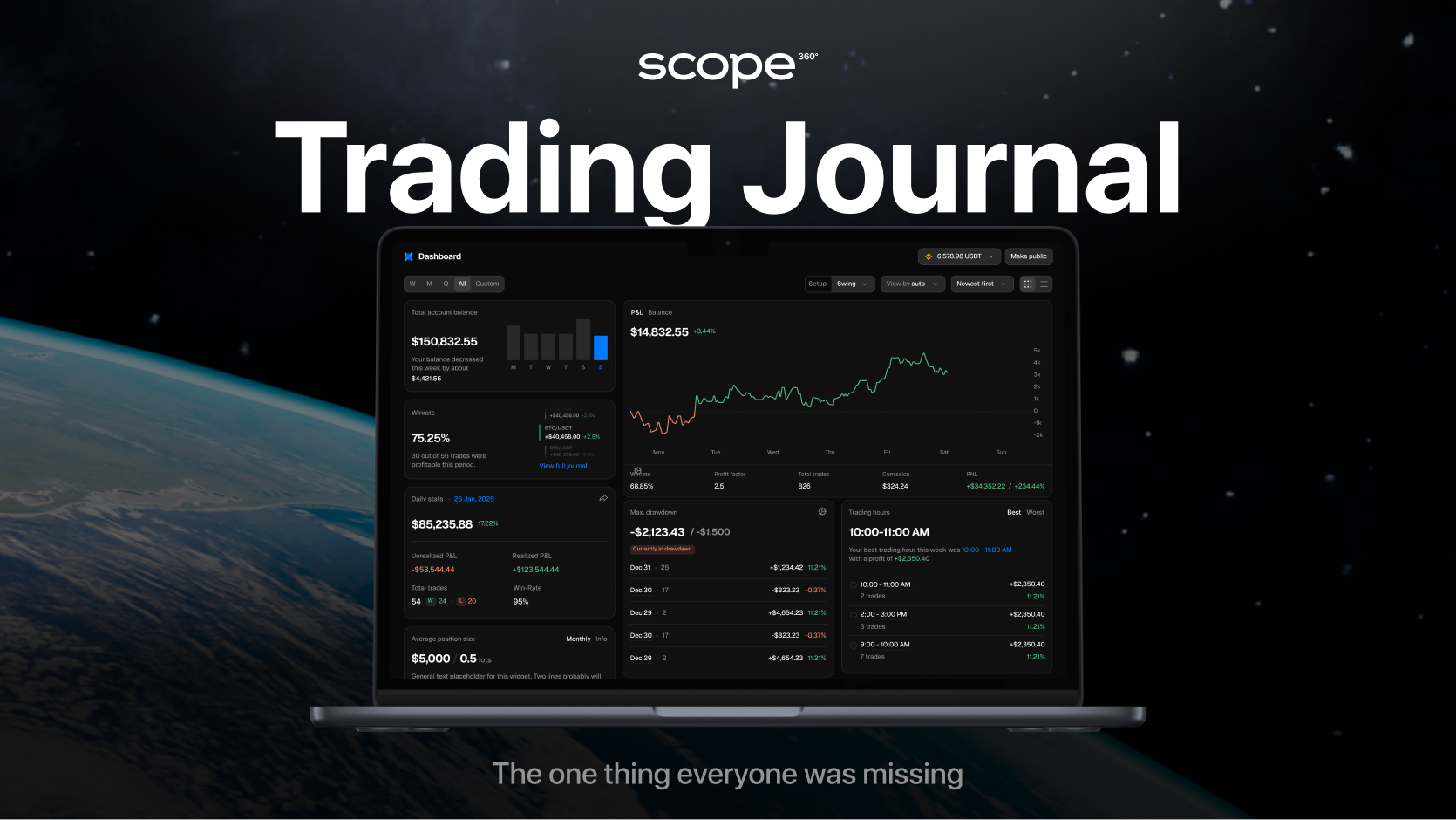
Both day traders and swing traders face different challenges: day traders struggle with maintaining focus all day, while swing traders must wait patiently for the right setup without closing too early. But they share the same need — structure and consistency. That’s exactly what Scope360° provides.
1. Automatic trade import
Connect directly via API to brokers or exchanges.
Upload trades via CSV if you keep records manually.
All trades flow into your journal instantly - without copying and pasting, no Excel spreadsheets.
2. A trade journal with context
Every trade is stored as a clear “card”:
instrument, date, size, result;
strategy or setup tags;
notes explaining entry and exit;
optional chart screenshots.
Why this matters:
For day traders - it helps review fast sequences of trades and avoid repeating mistakes.
For swing traders - it preserves the reasoning behind trades opened days or weeks ago.
3. Metrics that show the bigger picture
Scope360° automatically calculates dozens of performance metrics. Key ones include:
Metric | Why it matters |
PnL | The actual profit/loss of trades and strategies |
Win rate | Shows how often trades end profitably |
Risk/Reward | Checks if the reward justifies the risk taken |
Max & Daily Drawdown | Keeps track of drawdowns - critical for discipline |
Average trade duration | Ensures your trading matches your plan |
Consistency | Reveals whether results are steady or erratic |
4. Behavioral insights
Scope360° uncovers patterns that often go unnoticed:
overtrading (too many trades in a row),
exiting winners too early,
holding losers too long,
emotional “revenge” trades after losses.
For day traders, it protects against burning out mid-session.
For swing traders, it reinforces patience and sticking to the plan.
5. Discipline at every stage
Before trading. Review past results, filter out weak setups, focus on proven ones.
During trading. Track live PnL and daily drawdowns, stay within limits.
After trading. Tag and review trades, analyze notes, refine strategies.
6. Useful for both styles
Day traders gain clarity and structure in high-frequency trading.
Swing traders gain confidence to hold positions longer, based on evidence rather than emotion.
Scope360° turns a messy collection of trades into a structured process of journaling, metrics, and behavioral analysis. For day traders, it means being faster and sharper. For swing traders, it means keeping discipline and confidence over the long run.
Conclusion
Day trading and swing trading are two different styles, but both require discipline and structure. A day trader needs to react quickly to the market, while a swing trader must patiently wait for the right move. In both cases, success depends not only on the strategy itself, but also on how a trader analyzes trades and manages risk.
Scope360° helps with both:
keeps trades organized in a clear journal,
shows key performance metrics,
supports discipline and reveals common mistakes.
The bottom line: with Scope360°, traders get a clear picture of their trading - whether in day trading or swing trading.
Connect your exchange, get the full picture and trade with confidence.