
If you’re just starting out in trading, you’ve probably already come across strange words and abbreviations. The market has its own language - with its own rules and even a bit of slang. At first it may look confusing, but in reality it’s just a set of tools that help you read news, charts, and strategies more easily.
This glossary brings together the core terms traders use every day. No complicated definitions - just clear explanations with examples, so you can feel confident in any market conversation.
Basic Trading Terms
L - Long
Going long means buying an asset with the expectation that its price will rise. Example: you buy a stock at $100 and sell it a month later for $120. The $20 difference is your profit.
S - Short
A short is a trade where the trader profits from a fall in price. First, they borrow an asset from a broker and sell it at the current high price. Then, when the price falls, they buy the asset back at a lower price and return it to the broker. The difference between the sale and purchase price is their profit. Example: you sell Bitcoin at $30,000 and buy it back at $25,000 - the $5,000 difference is your gain.
L - Leverage
Leverage lets you trade with more money than you actually have. With $100 and 1:10 leverage, you can open a $1,000 position. Profits grow faster, but so do risks: just a small move against you can wipe out your account.
L - Lot
Assets like currencies are traded in “lots.” On classic forex, 1 lot = 100,000 units of the base currency. For beginners, the main point is that a lot is just a standard size for a trade, making risk easier to calculate.
P - Pip
A pip is the smallest price change in a currency pair. If EUR/USD moves from 1.1000 to 1.1001, that’s 1 pip. Many traders measure their trade results in pips.
S - Spread
Spread is the difference between the bid price (the highest price a buyer will pay) and the ask price (the lowest price a seller will accept) for a currency pair. The spread is the main transaction cost in forex trading, and it’s usually measured in pips. Lower spreads mean cheaper trades - high liquidity pairs like EUR/USD have tight spreads, while exotic pairs tend to have wider spreads.
Formula: Spread = Ask Price - Bid Price
Example: If EUR/USD is quoted at 1.1800 (bid) and 1.1802 (ask),
Spread = 1.1802 – 1.1800 = 0.0002 (2 pips)
S - Stop Loss and Take Profit
These are protective orders. A Stop Loss automatically closes a trade with a limited loss if the market goes against you. A Take Profit locks in profit at a chosen level. Together, they take emotions out of trading and keep risks under control.
Technical Analysis Terminology
С - Candlesticks
On charts, prices are most often drawn as “candlesticks.” Each candlestick shows where the price opened, where it closed, what the maximum and minimum were for the chosen period. Color also matters: a green candlestick means growth, a red one means decline. By combinations of candlesticks, traders read the market’s mood.
Т - Trend Line
A straight line drawn through consecutive highs or lows on the chart. It helps to see the general direction of movement: up, down, or sideways.
S - Support and Resistance Levels
The “floor” and “ceiling” of price. Support is the level below which an asset finds it difficult to fall. Resistance is the level above which an asset finds it difficult to rise. These zones are often used for trade entries and exits.
M - Moving Average
An indicator that smooths the price, showing the average value over a chosen period (for example, 50 or 200 days). It is used to understand the trend: if the price is above the average - the trend is more likely upward, below - downward.
F - Fibonacci Levels (Fibonacci Retracement)
A tool based on the mathematical Fibonacci sequence. It helps to find zones where the price may stop or reverse. Traders often use them to plan entries and exits.
Market Slang and Psychology
B - Bull Market
This is the term for a period of rising prices. Market sentiment is optimistic: traders and investors believe that assets will continue to grow in value and keep buying.
B - Bear Market
The opposite of a bull market. Prices are falling, sentiment is gloomy: most participants try to get rid of assets, expecting further declines.
F - FOMO (Fear of Missing Out)
The fear of missing an opportunity. A person sees others making money and jumps into a trade without analysis.
F - FUD (Fear, Uncertainty, Doubt)
Fear, uncertainty, and doubt. Panic triggered by rumors or negative news pushes the market down.
H - HODL
A joking misspelling of hold. Means holding an asset for a long time despite drops and fluctuations, hoping the price will recover.
P - Panic Selling
Mass selling driven by emotions. Usually caused by fear, which makes prices fall even faster.
D - Dead Cat Bounce
A short-term rise after a sharp fall. Often creates the illusion of a reversal, but then the trend continues downward.
B - Black Swan
A rare and unpredictable event that completely changes the market: a global crisis, sudden war, or pandemic. It cannot be predicted in advance.
G - Grey Swan
Not as rare as a black swan, but still unusual and capable of seriously affecting the market.
W - Whales
Large players with huge volumes. Their trades can move the market, and many traders watch their activity.
D - Diamond Hands
A trader holds an asset to the end, despite stress and falling prices.
P - Paper Hands
The opposite - closing positions too early out of fear of risk.
C - Correction
A short-term drop in prices after growth, or a temporary rise after a fall. Usually part of a global trend, not its reversal.
B - Breakout
A sharp move out of a flat or consolidation zone. Often accompanied by strong momentum.
R - Reversal
A change in trend direction: growth turns into decline, or vice versa.
M - Momentum
The strength and speed of price movement. The higher the momentum, the stronger the trend.
V - Volume
The total amount of assets bought or sold during a period. Confirms the strength of a move: high volume = strong trend.
Modern Terms from Crypto and the Stock Market
D - DeFi (Decentralized Finance)
Financial services on the blockchain: lending, staking, exchanges without banks. The key is the absence of intermediaries.
N - NFT (Non-Fungible Token)
A unique digital token confirming ownership of art, music, video, or even an in-game item.
D - DAO (Decentralized Autonomous Organization)
An organization without classic management. Decisions are made by token holders through voting.
S - Staking
Locking cryptocurrency for rewards. Essentially - the blockchain equivalent of a bank deposit.
A - Altcoin
Any cryptocurrency other than Bitcoin. Ethereum, Solana
M - Meme Coin
A token created for hype. Often has no fundamental value but can skyrocket suddenly (Dogecoin, Shiba Inu).
P - Pump and Dump
Artificially inflating the price followed by a sell-off. Most common with small-cap tokens.
S - Short Squeeze
A sharp rise in an asset when short sellers are forced to close positions with losses, pushing the price even higher.
R - Retail Investor
A regular individual trader, not a professional fund. A common term in both stock and crypto markets.
E - ETF (Exchange-Traded Fund)
An investment fund that trades on a stock exchange like a share. It holds a basket of assets, such as stocks, bonds, or commodities, often designed to track the performance of an underlying index (e.g., the S&P 500). ETFs offer investors instant diversification, low costs, and the ability to buy and sell throughout the trading day at market prices.
S - SPAC (Special Purpose Acquisition Company)
A shell company created only to take another company public through a merger. A popular stock market tool in recent years.
Conclusion
Trading has its own language - from basic terms like long and short to modern crypto slang like HODL and meme coins. The more of this language you know, the easier it is to follow news, understand strategies, and communicate with other traders.
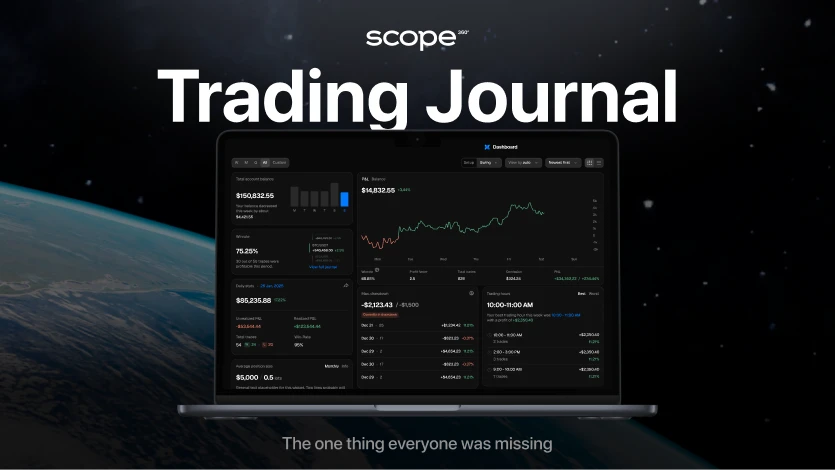
Scope360° helps take this knowledge further: not only do you understand the terms, but you also see them in action inside your own journal. Trades, strategies, emotions, and risk metrics - everything is logged automatically, so your learning doesn’t stay on paper but turns into real practice.