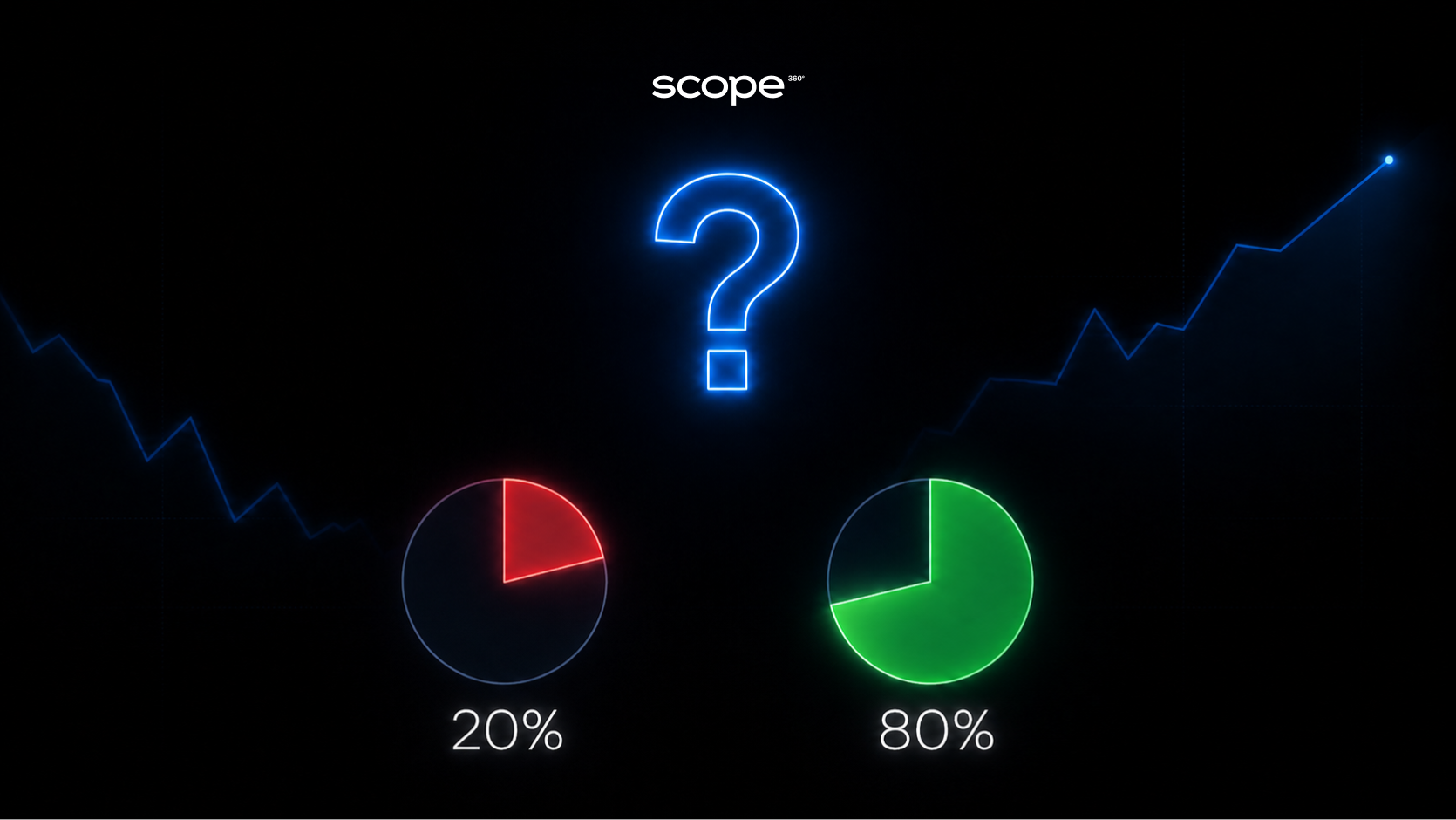
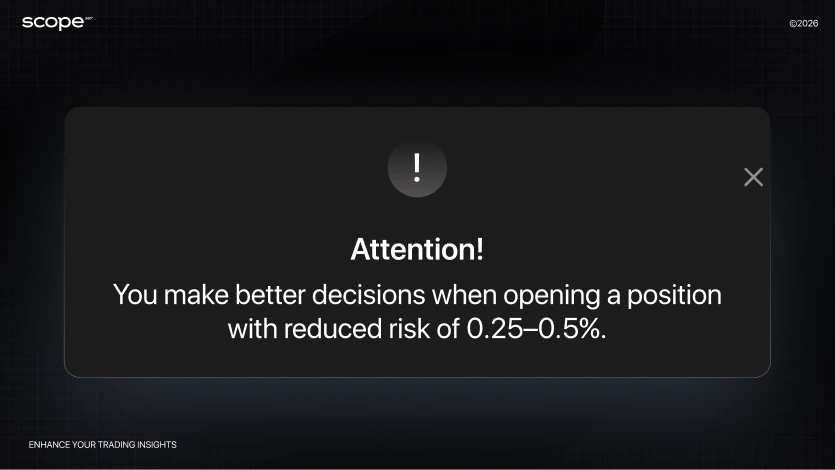
In trading, risk isn’t an accident - it’s built into every position, just like your entry point or chart setup. The question is whether you manage it consciously or let it control you.
Most traders don’t fail because of weak strategies, but because they mismanage risk: oversizing positions, breaking limits, chasing bad trades. At the core of consistent performance is capital protection - and Scope360° gives you the tools to make risk management the foundation that keeps you in the game.
What Is Risk Management in Trading
Risk management is a system for controlling potential losses in the trading process. Unlike a strategy, which answers the question “where to enter,” risk management answers the question “how much can you afford to lose if things don’t go as planned.”
Risk is present in every trade. Even the strongest trading idea doesn’t guarantee results. That’s why a trader’s job is not to avoid risk, but to manage it: to set boundaries, control consequences, and preserve capital when the market moves against them.
It’s important to understand: risk is not an emotion, it’s a measurable value. It’s expressed as a percentage of capital, as stop-loss size, as the probability of a loss. Risk can be calculated, limited, and built into the structure of a trading system.
Risk management isn’t about fear - it’s about control. It’s a set of rules that protects the trader from impulsive decisions and destructive emotions. It helps maintain objectivity, survive losing streaks, and stay in the game over the long term.
In essence, risk management is the foundation of a professional approach to trading. Without it, any strategy will eventually turn into a game of chance. With it, even an average strategy can deliver consistent results.
Core Principles of Risk Management
Risk management isn’t a random set of restrictions - it’s a structured system that helps traders manage capital with foresight and control. It’s built on the following key principles:
1. Identifying, Assessing, and Measuring Risk
Risk management starts with identifying potential threats: market volatility, liquidity gaps, and psychological behavior. Then the likelihood and magnitude of loss are assessed - typically as a percentage of capital or maximum drawdown. This allows traders to understand consequences before taking action.
2. Limiting Risk per Trade
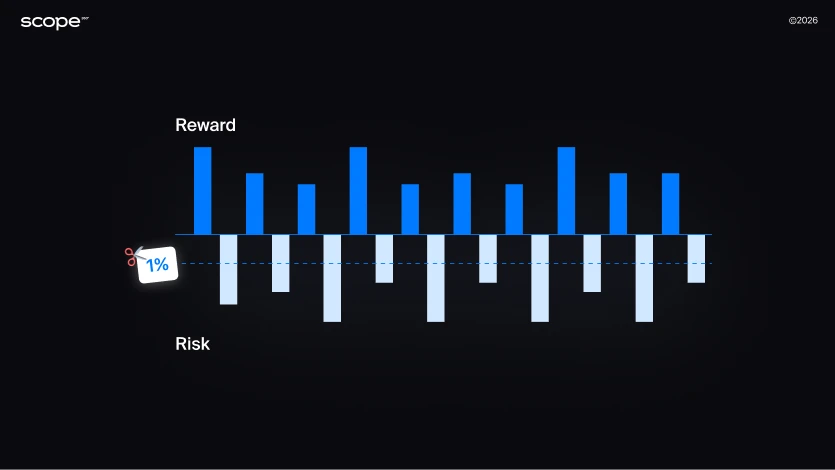
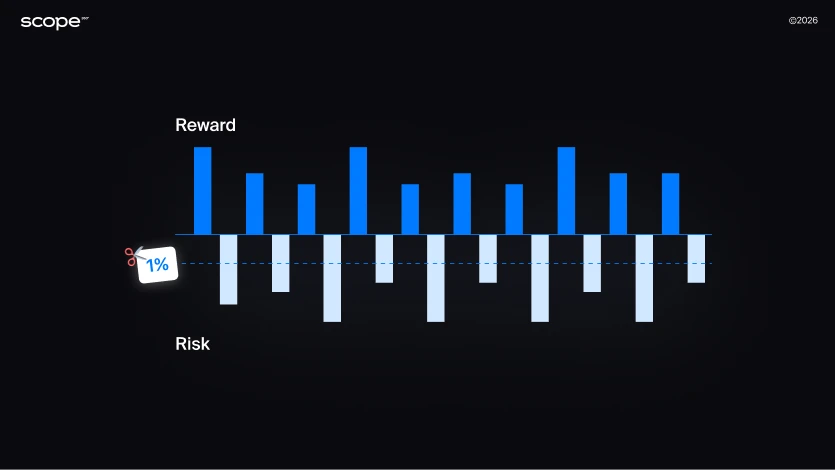
A common guideline is to risk no more than 1–2% of your capital on a single trade. This significantly reduces the chance of major drawdowns and allows the system to stay intact even through a losing streak.
3. Risk/Reward Ratio
Before entering a position, traders evaluate the potential reward relative to the risk. A minimum ratio of 1:2 is generally considered acceptable. This gives a statistical edge even if the win rate is modest.
4. Daily, Weekly, and Monthly Loss Limits
Setting maximum loss thresholds over fixed periods helps prevent escalation. For example: no more than 3 losing trades per day, or a weekly drawdown limit of 5%. These rules serve as circuit breakers that protect the account from emotional decisions.
5. Position Sizing and Overall Exposure
Position size should be calculated based on volatility, stop-loss distance, and allowed risk. Additionally, traders must monitor total exposure across all open trades - especially if assets are correlated - to avoid system-wide risk.
6. Diversification
Spreading capital across different strategies or uncorrelated assets reduces risk. Diversification prevents one failed idea or sector from wiping out the entire account.
7. Discipline and Rule Execution
Risk management only works when rules are followed. Proper stop-loss placement, adherence to trade plans, and emotional control are essential. Discipline is the invisible structure behind consistent performance.
8. Monitoring, Review, and Adaptation
Markets change, and so should your risk controls. Reviewing trade data, reassessing risk thresholds, and backtesting performance ensures the system remains relevant and resilient.
Summary
Risk management is a structured approach to measuring, limiting, and controlling losses.
It includes rules like position sizing, loss limits, risk/reward evaluation, and overall exposure control.
Without discipline and regular review, even the best system becomes fragile.
Continuous tracking, testing, and adaptation are key to staying effective in changing market conditions.
Key Risk Management Metrics
To manage risk effectively, you need to measure it. Metrics provide an objective view of how well your capital is protected and how consistent your trading system really is.
Core Metrics:
1. Risk per Trade (% of capital)
This is the percentage of your account you're willing to risk on a single trade - typically 1–2%. Staying within this limit allows you to survive a long losing streak without blowing up your account.
2. Risk/Reward Ratio (RR)
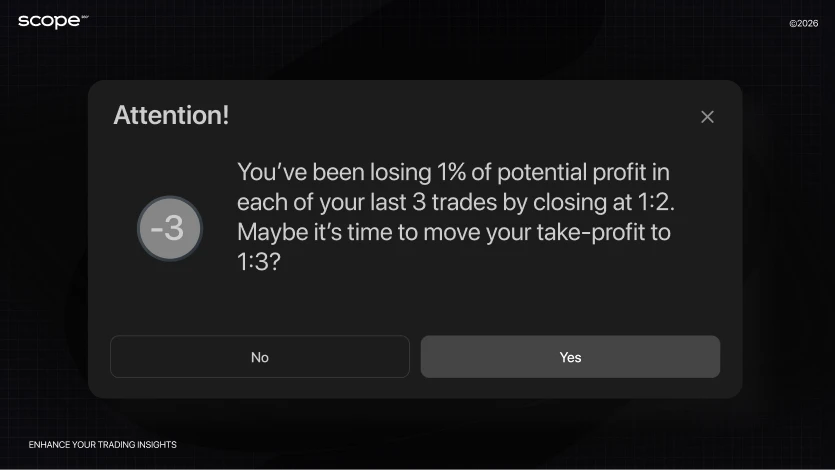
This shows how much potential profit you aim for compared to how much you risk. If your RR is 1:3, you risk $100 to potentially make $300. A high RR reduces the win rate needed to stay profitable.
3. Win Rate & Loss Rate
Win rate is the percentage of profitable trades. Loss rate is the opposite. These numbers only make sense when viewed alongside RR - for example, a 40% win rate can still be profitable if your RR is strong.
4. Expectancy
Formula: (Win Rate × Avg Win) - (Loss Rate × Avg Loss)
It tells you how much, on average, you earn (or lose) per trade. If your expectancy is positive, your system works over time - even with a modest win rate.
5. Maximum Drawdown
This is the largest decline from a peak to a trough in your equity curve. A 20% drawdown means you need a 25% gain just to recover. High drawdowns increase financial and emotional stress - a critical risk marker.
6. Profit Factor
The ratio of gross profits to gross losses. A value above 1 means you're profitable overall. A PF of 2 means you earn $2 for every $1 you lose - a sign of strong system efficiency.
7. Sharpe Ratio
Measures how much return you’re getting for each unit of total volatility (both upside and downside).
Formula:

A Sharpe above 1 means your strategy delivers solid returns relative to its volatility, making it useful for comparing different systems.
8. Sortino Ratio
Similar to Sharpe, but focuses only on downside volatility (negative returns) instead of all fluctuations.
Formula:

Ideal for strategies that aim to minimize losses rather than maximize total gains. A higher Sortino means better risk-adjusted returns when considering only harmful volatility.
Metrics Comparison
Metric | What it shows | Why it matters |
Risk per Trade | Max risk per trade as % of capital | Prevents account blow-ups |
Risk/Reward Ratio | Profit potential vs. risk | Lets you win less and still profit |
Win Rate | % of winning trades | Only useful with RR considered |
Expectancy | Average profit per trade | Measures the true performance of a system |
Drawdown | Worst equity dip | Shows stress level and recovery needs |
Profit Factor | Gross profit ÷ gross loss | Indicates overall profitability |
Sharpe / Sortino | Return adjusted for volatility and risk | Helps compare systems and smoothness |
Summary:
Metrics give you visibility and control - you can see where risk is too high or where strategy is working.
Analyzing these numbers together is the best defense against randomness and emotional trading.
Scope360° calculates all key metrics automatically and integrates them into your daily workflow.
Even beginner traders can rely on these numbers to build a more structured, data-backed approach.
Common Mistakes in Risk Management
Even with a solid trading strategy and market knowledge, many traders lose money - not because of poor analysis, but due to systemic risk management failures. Here are the most common ones:
Lack of Clear Rules: Many traders rely on instinct: they set stops arbitrarily, don’t calculate position risk, and ignore loss limits. Without structured rules, risk management ceases to be a system and turns into improvisation.
Increasing Risk After Losses (Revenge Trading): Trying to “make it back” after a loss is one of the most dangerous habits. Traders raise position sizes, ignore rules, and chase fast recovery - which usually leads to deeper drawdowns, not recovery.
Overestimating Win Rate, Ignoring Risk/Reward: New traders often focus solely on entry accuracy and ignore the risk/reward ratio. As a result, even systems with a 70% win rate can be unprofitable if losses are too large and profits too small.
Underestimating Total Exposure: Opening multiple correlated positions (e.g., BTC, ETH, SOL) isn’t diversification - it’s amplifying the same directional risk. You might think you have three trades, but in reality it’s one large bet on the same market move.
Ignoring Trade Data and Statistics: Without a journal and performance analytics, traders remain blind to their real issues. Not tracking MAE, MFE, drawdowns, or expectancy makes it impossible to adjust behavior or improve performance systematically.
Trading Outside the Plan: Even with a strong system, traders sometimes break rules: entering impulsive trades, moving stops, or oversizing positions. These emotional deviations often cause major losses and destroy the consistency of the strategy.
These mistakes aren’t limited to beginners. They happen to anyone who doesn’t follow a structured system or track their behavior through data. That’s why Scope360° helps traders log their trades, calculate key metrics, track behavioral errors, and stay disciplined.
How Scope360° Helps You Build a Risk Management System
Risk management is not just theory about stop-losses and the 1% rule. It’s a system that must be embedded in every trading decision. Scope360° was built specifically as a tool that makes risk management practical, measurable, and repeatable.
Here’s how it works on the platform level:
1. Full Control Over Risk Parameters
Scope lets you set and track specific risk limits:
risk per trade (as % of account or fixed amount),
daily and weekly loss limits,
limits on number of trades per day,
minimum required risk/reward ratio (RR).
These parameters are saved as rules and checked against every trade. If you deviate - the platform flags it.
2. Automatic Calculation of All Key Metrics
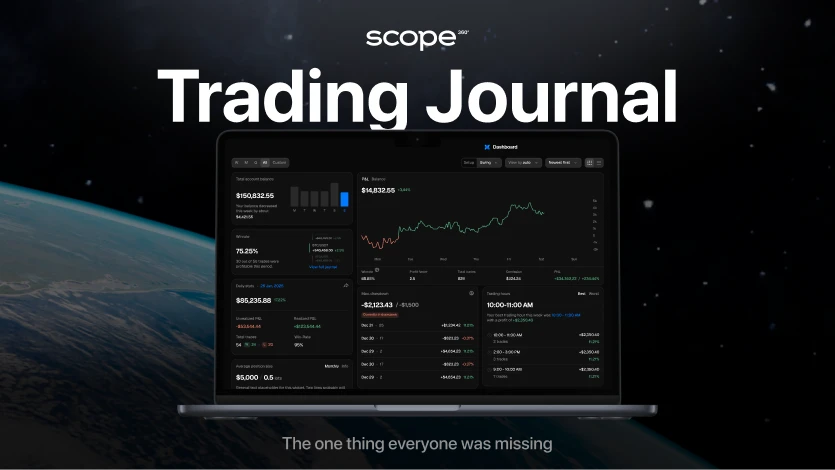
Scope automatically calculates:
Risk/Reward Ratio (per trade and overall),
Expectancy - expected profitability of your system,
Profit Factor, win rate, drawdown, MAE/MFE, and dozens of other metrics.
No spreadsheets needed - you instantly see how well you're managing risk in numbers.
3. Behavioral Analysis and Error Tracking
Scope doesn’t just record trade results. It analyzes your behavior:
flags rule violations (moved stop-loss, held past drawdown, over-risked),
lets you tag trades (e.g., “emotional entry”, “revenge trade”, “missed signal”),
highlights recurring mistakes and behavioral patterns.
This helps you fix systemic issues that often go unnoticed.
4. Dynamic Calendar and Trade Reports
The platform visualizes your trading over time:
profit/loss by day, week, session,
drawdown spikes,
days with risk management violations.
This helps you assess not just strategy performance, but behavioral discipline as well.
5. Complete Audit Trail and Transparency
Every decision you make - trade reasoning, entry parameters, result, behavioral conclusion - is logged in the platform. This creates a logical chain:
Plan → Trade → Outcome → Analysis → Adjustment
This is especially important for traders in prop firms, where discipline and accountability determine whether you get access to the next level of capital.
Scope360° doesn’t just help you measure risk - it helps you build your trading around it. This isn’t a side tool - it’s the core of your system. It turns risk management from theory into practice: with numbers, feedback, and clear control over your actions.
Conclusion
In trading, it’s not enough to know when to enter. You need to understand how much you can afford to lose - and where to stop.
Scope360° helps you build risk management not as theory, but as a working system - with numbers, boundaries, rules, and feedback.
If you want to trade with discipline, clarity, and long-term focus - start by taking control of your risk.
Keep going
Create an account, connect your exchanges via API, and set clear risk limits and rules.
Scope360° is built for traders who want full control over their risk - with structure, data, and discipline.
See your trading in full perspective.