
Does a profitable trade necessarily result from correct decisions, whilst a loss-making one results from incorrect ones?
No.
In a 1988 study by Jonathan Baron and John Hersey, participants were shown decisions made under conditions of uncertainty. These included medical scenarios and monetary bets with known probabilities.
People were given all the information available to the decision-maker at the time the decision was made, after which they were told the outcome and assessed the quality of the decision-maker’s reasoning, their competence and the soundness of their choice.
A decision that was logically sound could either end in success or lead to failure.
The study showed that a successful outcome significantly improves the assessment of the decision.
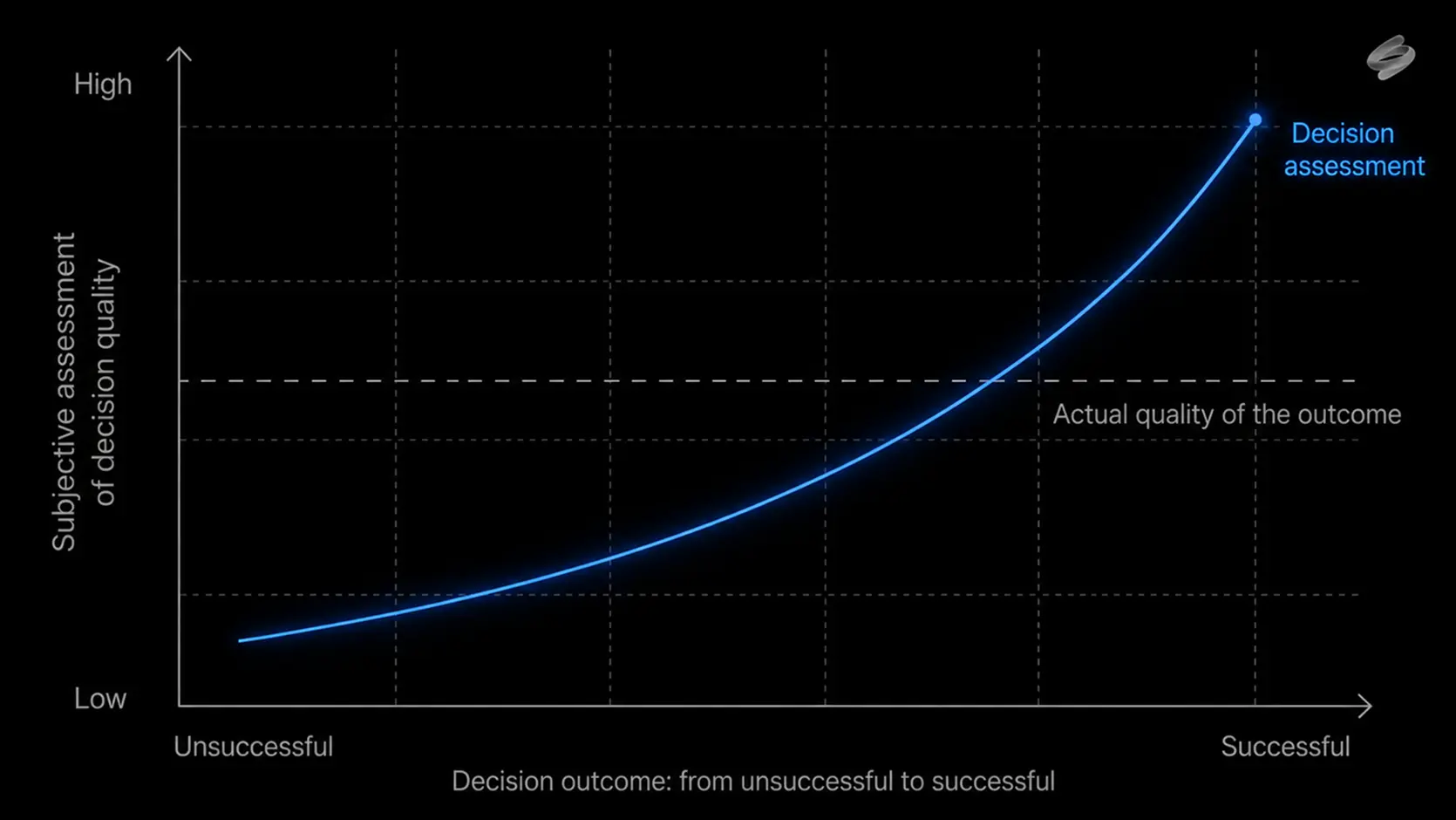
A person is considered more competent, their reasoning of higher quality and more substantial, and the choice itself more sensible. An unsuccessful outcome, by contrast, lowers their perceived competence and professionalism in the eyes of others, even though the conditions were exactly the same at the time the decision was made.
This is known as outcome bias.
We use the consequences of a decision as an indicator of how good the decision itself was.
In 2023, a replication of the first study was carried out—in case the original study seemed a bit outdated or lacked sufficient statistical power—involving 692 participants, with a modified experimental design and participants divided into independent groups.
The effect reappeared and turned out to be quite significant.
The most interesting thing is that the bias persisted even among people who explicitly stated that the outcome should not be taken into account at all when evaluating a decision. In other words, they understood the correct principle but immediately violated it with their own assessments. Does this sound familiar?
What does this have to do with trading?
Making a profit whilst regularly trading on news, taking on excessive risk, moving stop-loss orders or making other deviations from one’s strategy – whether we like it or not – will be perceived as a sign of experience and sound judgement.
This behaviour creates the conditions for increased self-confidence and a misperception of results based on distorted information.
Then, a high-quality trade setup may result in a stop-loss being triggered, after which the trader begins to look for errors in their analysis, change the rules and abandon their trading conditions, even though such a loss could simply be a normal part of the statistical distribution of their strategy’s results.
It is better to take a stop-loss on a trade in line with your strategy than to chase random winning streaks.
An analytics platform for crypto and FX traders. Try it for free.