Win rate is one of the first metrics traders notice when reviewing their performance. It is easy to understand, easy to compare and psychologically satisfying when the number is high.
The problem is that win rate says very little about profitability on its own.
A trader may win eight out of ten trades and still lose money. Another may lose more often than they win while steadily growing their account. The difference usually comes down to the relationship between the frequency of profitable trades and the size of wins and losses.
That relationship is measured through trading expectancy, also known as mathematical expectation in trading.
Expectancy estimates how much a strategy earns or loses, on average, each time a trade is opened. More importantly, it helps answer a practical question:
If the same trading process is repeated over the next 100, 500 or 1,000 trades, is it likely to remain profitable?
This makes expectancy one of the most useful metrics for evaluating a trading strategy over a meaningful sample rather than judging it by a few recent outcomes.
What Is Expectancy in Trading?
Trading expectancy is the average expected result of one trade based on four variables:
the percentage of profitable trades;
the average size of a winning trade;
the percentage of losing trades;
the average size of a losing trade.
A positive expectancy suggests that a strategy has a statistical edge under the conditions represented by the data. A negative value suggests that the current combination of trade selection, execution and risk management loses money over time.
Expectancy does not predict the result of the next trade. A strategy with an expectancy of +0.5R can still produce several consecutive losses. The metric becomes meaningful across a sufficiently large group of trades, where individual outcomes have less influence on the overall result.
For example:
+0.5R expectancy means the strategy earns approximately 0.5R per trade on average.
−0.2R expectancy means the strategy loses approximately 0.2R per trade.
0R expectancy means the strategy is near breakeven before commissions, fees and slippage are considered.
Here, R represents the amount initially risked on a trade. If a trader risks $100, then 1R equals $100. If the risk is $1,000, then 1R equals $1,000.
Using R-multiples makes it easier to compare performance across different accounts, instruments and position sizes.
The Trading Expectancy Formula
The standard trading expectancy formula is:
Expectancy = (Win Rate × Average Win) − (Loss Rate × Average Loss)
Where:
Win Rate is the percentage of profitable trades.
Average Win is the average return from winning trades.
Loss Rate is the percentage of losing trades.
Average Loss is the average size of a losing trade.
Win rate and loss rate should be written as decimals. A win rate of 50%, for example, is entered as 0.50.
The result of this calculation represents expectancy per trade.
To estimate the expected result over a specific number of trades, multiply expectancy by the number of trades:
Expected result over N trades = Expectancy per trade × Number of trades
If the result is measured in R, it can then be converted into account currency:
Expected monetary result = Expectancy in R × Risk per trade × Number of trades
The number of trades should not be included in the basic expectancy formula itself. Doing so would mix the average expected result of one trade with the projected result of the entire sample.
Trading Expectancy Calculation Example
Consider a strategy with the following statistics:
Win Rate: 50%
Average Win: +2R
Average Loss: −1R
The expectancy calculation would be:
(0.50 × 2R) − (0.50 × 1R) = +0.5R
The strategy therefore earns an average of 0.5R per trade.
If the trader risks $100 per position:
0.5R × $100 = $50
Over 100 trades, the projected result would be:
$50 × 100 = $5,000
This does not mean the trader should expect a smooth sequence of identical results. The actual distribution may contain losing streaks, drawdowns, unusually large winners and periods when market conditions are less suitable for the strategy.
Expectancy describes the average outcome implied by historical data. It does not remove variance.
Why Expectancy Matters More Than Win Rate Alone
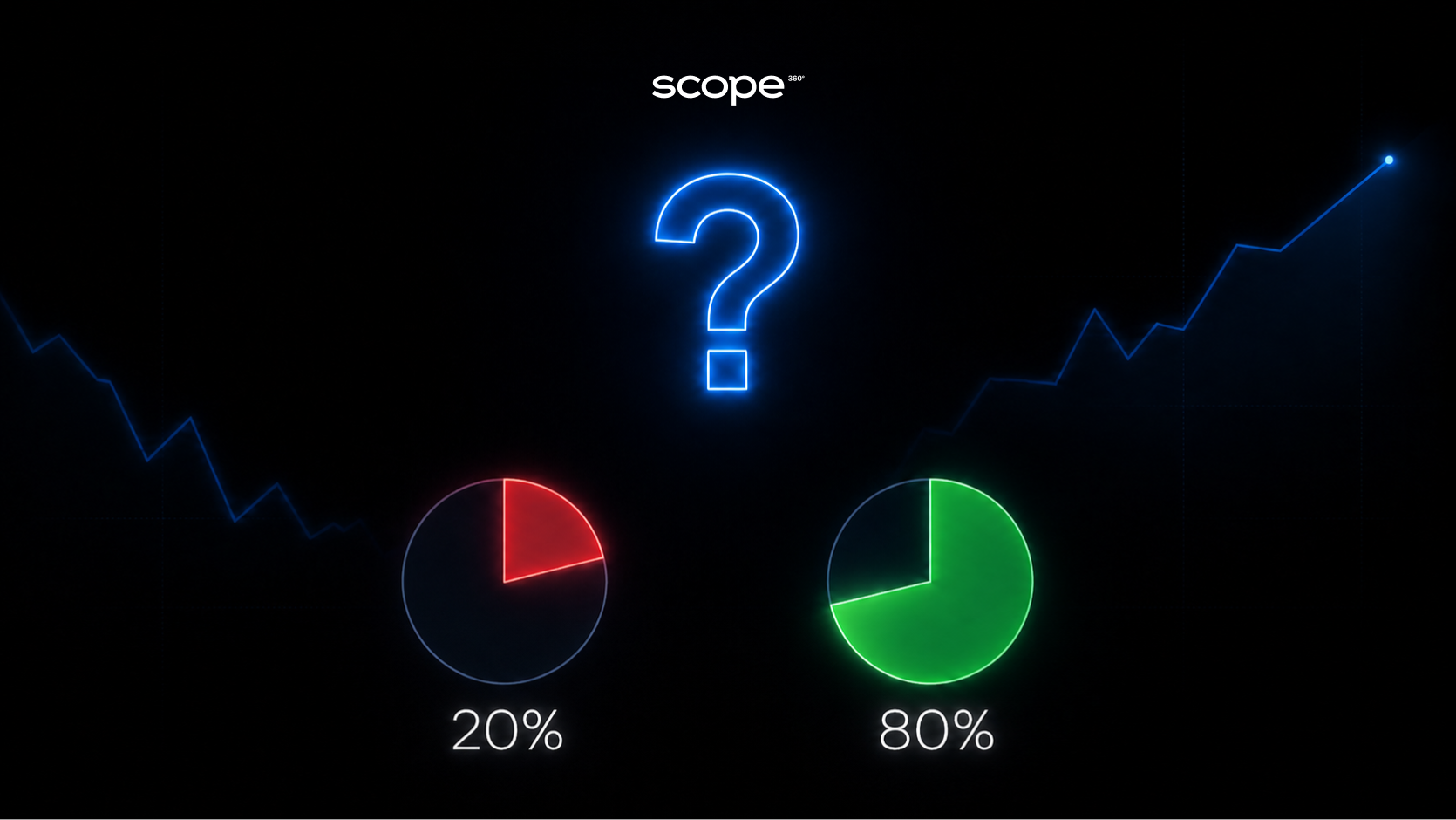
A high win rate often feels like proof that a strategy works. In reality, it only shows how frequently trades close in profit. It does not show whether those profits are large enough to cover the losses.
Consider a trader who completes ten trades with an 80% win rate:
8 winning trades at +0.5R each: +4R
2 losing trades at −3R each: −6R
The overall result is:
+4R − 6R = −2R
The trader was profitable on eight of ten trades and still lost money.
Now consider a different strategy with a 40% win rate:
4 winning trades at +3R each: +12R
6 losing trades at −1R each: −6R
The overall result is:
+12R − 6R = +6R
The second trader loses more often but has a much stronger relationship between average profit and average loss.
This is the limitation of using win rate as the main measure of trading performance. It rewards frequency without accounting for economic value.
A more complete interpretation is:
Win rate shows how often a strategy wins.
Average win and average loss show the size of its outcomes.
Expectancy combines both and shows whether the overall process has a positive edge.
Positive, Negative and Breakeven Expectancy
The basic interpretation of trading expectancy is straightforward.
Positive expectancy
When expectancy is above zero, the strategy has historically produced more value from winning trades than it has lost from losing trades.
For example:
Expectancy = +0.3R
This means that each trade has contributed approximately 0.3R on average across the analyzed sample.
Negative expectancy
When expectancy is below zero, the strategy loses money over time under its current parameters.
For example:
Expectancy = −0.1R
The trader may still have profitable weeks or months, but the average trade is working against them.
Breakeven expectancy
An expectancy near zero means that gross profits and losses are approximately balanced.
In practice, a strategy with exactly zero expectancy is usually unprofitable after commissions, funding costs, spreads and slippage are included.
The Strength of a Trading Edge
Positive expectancy confirms that a strategy has produced an edge, but it does not show whether that edge is strong enough to be useful.
Compare two systems:
System A: +0.1R expectancy
System B: +0.6R expectancy
Both are profitable based on the available data. However, System B generates six times more expected value per trade.
At the same risk level and over the same number of trades, it should produce significantly higher returns.
That does not automatically make System B suitable for every trader. It may have a lower win rate, longer losing streaks or greater drawdowns. A strategy must be evaluated not only by its expected return but also by the path required to achieve it.
This is why expectancy should be analyzed alongside other trading performance metrics.
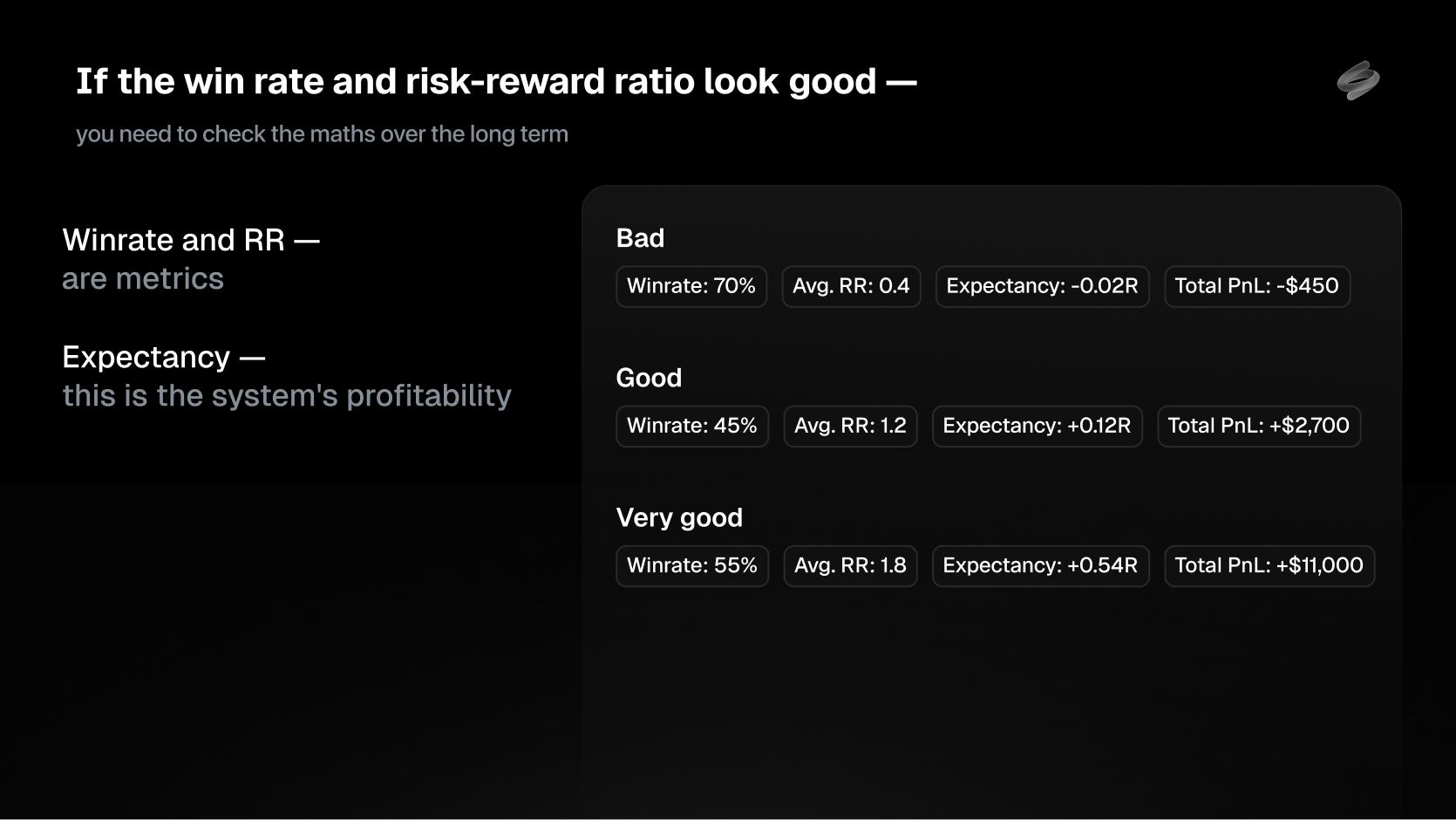
Expectancy and Win Rate
Comparing expectancy with win rate helps reveal whether a change in accuracy is actually improving the strategy.
Win rate decreases while expectancy increases
This can happen when a trader begins holding profitable positions longer or targeting larger returns.
There may be fewer winning trades, but each winner contributes more to the overall result. In that case, the lower win rate is not necessarily a problem.
Win rate increases while expectancy decreases
This is often a warning sign.
It may indicate that the trader is:
closing profitable trades too early;
reducing targets;
moving stops to breakeven too quickly;
accepting small wins while allowing occasional large losses.
The strategy feels more comfortable because winning trades occur more frequently, yet the economic value of each trade is declining.
Higher accuracy is only useful when it improves the overall mathematical expectation.
Expectancy and Average Risk-Reward Ratio
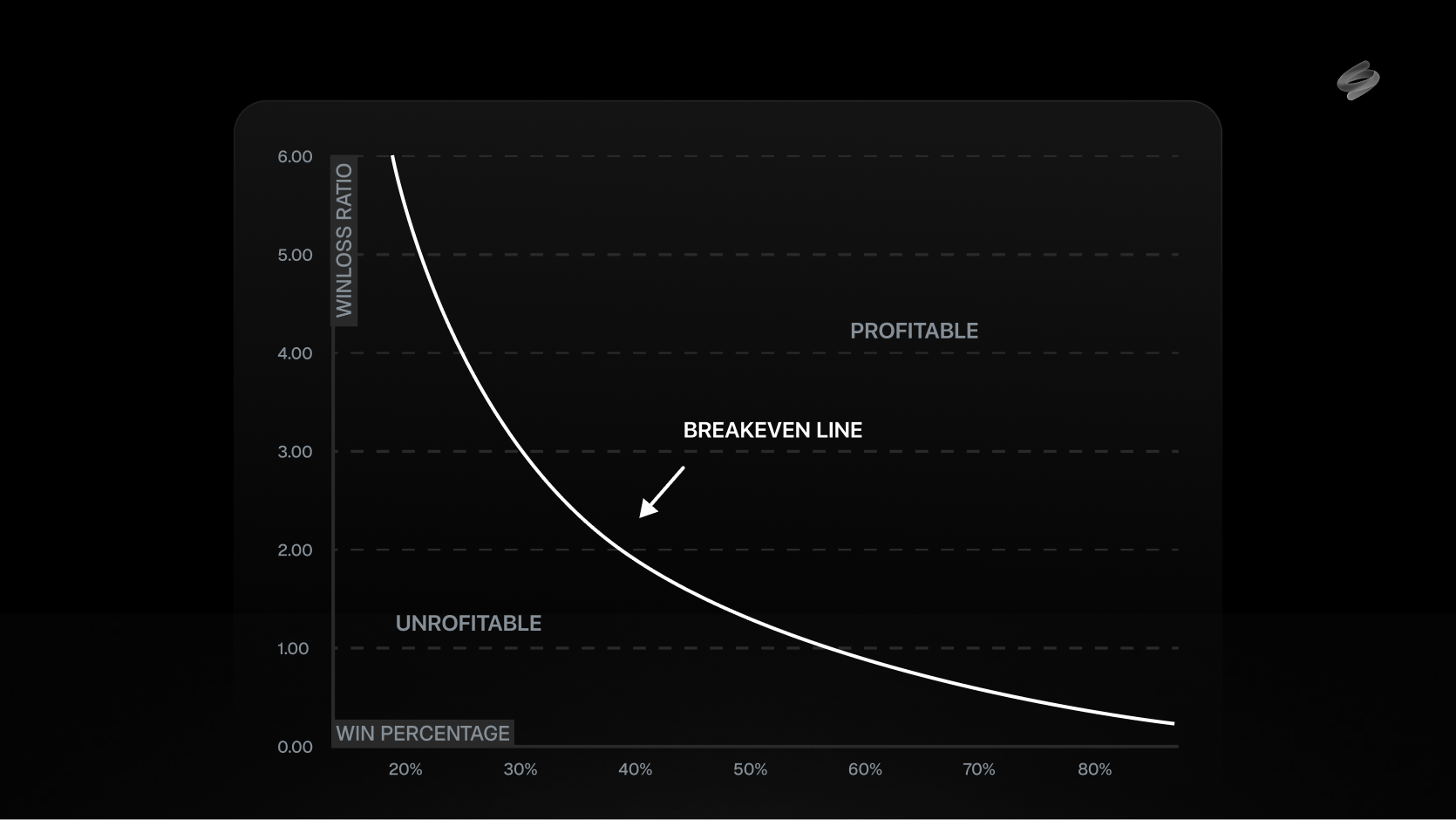
The relationship between expectancy and average risk-reward ratio can show whether trade management is improving or weakening the strategy.
When both average RR and expectancy increase, the system is extracting more value from profitable trades.
When both decline, the trader may be reducing winners through:
early manual exits;
excessive partial profit-taking;
emotional reactions to unrealized PnL;
aggressive breakeven management;
failure to follow planned targets.
It is important to distinguish between planned RR and realized RR.
A setup may initially offer a target of 3R, but if trades are consistently closed around 0.8R, the strategy should be evaluated using the realized result. Planned targets do not contribute to profitability. Executed outcomes do.
Average RR should also be interpreted carefully when losses are not consistently limited to −1R. If some losing trades exceed the intended risk, the average win and average loss provide a more accurate expectancy calculation than a simplified RR figure.
Expectancy and Breakeven Trades
Breakeven trades are often treated as neutral outcomes. They do not create an immediate loss, but they can still reduce the profitability of a strategy.
Suppose the percentage of breakeven trades rises while expectancy falls. This may indicate that stops are being moved to entry before the market has had enough room to develop.
As a result, positions that could have reached their targets are being converted into zero-return trades.
A breakeven rule should therefore be tested rather than used as an automatic form of emotional protection.
Useful questions include:
How many breakeven trades would have reached the original target?
How many would have reached the original stop?
Does the breakeven rule reduce maximum drawdown?
Does it improve or reduce overall expectancy?
At what stage of the trade does moving the stop become statistically justified?
The purpose of breakeven management is not simply to avoid losses. It should improve the long-term distribution of results.
Expectancy and Drawdown
Expectancy measures average return per trade. Drawdown shows the decline an account may experience while that edge plays out.
The strongest improvement occurs when expectancy rises while drawdown falls. The strategy is producing more value with less downside pressure.
If expectancy rises alongside a sharp increase in drawdown, the improvement may be the result of greater risk rather than better execution.
In that situation, the trader should review:
risk per trade;
position sizing;
exposure across correlated positions;
maximum drawdown;
average drawdown;
simultaneous open risk;
changes in trade frequency.
A higher expected return is not necessarily an improvement if it requires an unacceptable level of account volatility.
This is especially relevant for prop trading, where drawdown limits can invalidate an otherwise profitable strategy before its edge has time to materialize.
Expectancy and Losing Streaks
A profitable strategy can still produce long sequences of losses.
For example, a system may have an expectancy of +0.6R while also producing a maximum losing streak of 10 or 12 trades.
Mathematically, the system may be strong. Psychologically, it may be difficult to execute.
Long losing streaks can lead traders to:
reduce risk after the losses have already occurred;
increase risk in an attempt to recover;
skip valid setups;
change rules in the middle of a sample;
abandon the system before the next profitable sequence.
This does not necessarily mean the strategy is flawed. It may mean that its return distribution does not match the trader’s risk tolerance or decision-making style.
A realistic evaluation of a trading system must account for both its expected return and the emotional pressure created by variance.
Expectancy by Trading Setup
Account-wide expectancy provides a useful overview, but it can hide major differences between individual setups.
Consider two setups:
Setup A
Win Rate: 45%
Average Win: +3R
Average Loss: −1R
Expectancy: +0.8R
Setup B
Win Rate: 65%
Average Win: +1.1R
Average Loss: −1R
Expectancy: +0.2R
Setup B wins more often and may feel easier to trade. Setup A, however, contributes considerably more value per trade.
Analyzing expectancy by setup helps traders identify:
which models create the strongest edge;
which setups are profitable only under certain market conditions;
which trades add activity but not value;
where execution differs from the trading plan.
The same analysis can be applied by instrument, session, timeframe, direction or market regime.
What Causes Trading Expectancy to Decline?
Expectancy rarely changes without a reason. A decline usually reflects changes elsewhere in the trading process.
Common causes include:
a lower win rate;
smaller average winners;
larger average losses;
more breakeven trades;
weaker setup selection;
increased commissions or slippage;
overtrading;
changes in market conditions;
inconsistent risk per trade;
deviations from the trading plan.
Before changing the strategy, the trader should identify which component has deteriorated.
For example, a falling win rate may result from a difficult market regime rather than poor execution. A lower average win may come from early exits. A larger average loss may indicate that stops are being moved or ignored.
Expectancy shows that performance has changed. Supporting metrics explain why.
Common Errors When Calculating Expectancy
Using too few trades
Expectancy based on ten or twenty trades can be distorted by one unusually large result.
A larger sample provides a more reliable picture. While there is no universal minimum, 100 trades is a more useful starting point than a handful of recent positions.
The appropriate sample size also depends on trade frequency and strategy type. A swing trader may need more time to collect data than an intraday trader.
Ignoring trading costs
Commissions, spreads, funding payments and slippage reduce realized expectancy.
For high-frequency and short-term strategies, these costs can determine whether a small edge remains profitable.
Combining unrelated strategies
Mixing different setups, instruments and market conditions into one number can make the result too broad to be actionable.
A profitable setup may be offsetting losses from another without the trader noticing.
Optimizing for win rate
Increasing win rate can weaken a strategy if it requires smaller targets, wider stops or frequent early exits.
The goal is not to maximize the number of winning trades. The goal is to improve the expected value of the overall process.
Using planned results instead of realized results
Expectancy must be calculated from actual outcomes.
A trade planned at 4R but closed at 1R contributes 1R to the data. The original target may be useful for reviewing execution, but it cannot be treated as realized performance.
How to Use Expectancy in a Trading Journal
A practical expectancy analysis can be structured into several stages.
First, collect a meaningful sample of trades and record the results in R-multiples. This makes the data comparable even when position sizes or account balances change.
Next, calculate:
win rate;
average win;
average loss;
realized risk-reward ratio;
expectancy per trade;
breakeven frequency;
maximum drawdown;
maximum losing streak;
expectancy by setup.
Then segment the trades by variables that may affect performance:
setup;
instrument;
market session;
timeframe;
long or short direction;
market condition;
planned and realized management.
Finally, compare the results across different periods. A single expectancy value is useful, but the direction of change often provides more information.
A rising expectancy may show that setup selection or trade management is improving. A falling expectancy may indicate execution drift, weaker market conditions or changes in risk behavior.
Any adjustment should be tested one variable at a time. Changing entries, exits, risk and setup criteria simultaneously makes it difficult to determine what affected the result.
Expectancy Does Not Guarantee Future Returns
Expectancy is based on historical data. It assumes that the strategy, execution and market environment remain sufficiently similar for the past sample to remain relevant.
That assumption will not always hold.
Market volatility changes. Liquidity changes. A setup may perform differently during trends and ranges. Execution may deteriorate under pressure. A profitable historical edge may weaken over time.
For that reason, expectancy should be monitored continuously rather than calculated once and treated as a permanent property of the strategy.
It is best viewed as an evolving measurement of the current trading process.
Final Thoughts
Short-term PnL can be misleading.
A trader may make money through a sequence of favorable outcomes while following a negative-expectancy process. Another may experience a temporary drawdown while executing a strategy with a genuine statistical edge.
Expectancy helps separate these situations.
It moves the analysis away from isolated trades and toward the structure of the trading system:
how often the strategy wins;
how much it earns from winners;
how much it loses from losing trades;
how those variables interact over a large sample.
Win rate shows how frequently a trader is right. Average win and average loss show the financial consequence of being right or wrong. Expectancy brings those elements together and shows whether the strategy has produced a sustainable edge.
That is why mathematical expectation is not merely another figure in a trading journal. It is one of the clearest ways to evaluate whether a trading process is worth continuing, adjusting or abandoning.
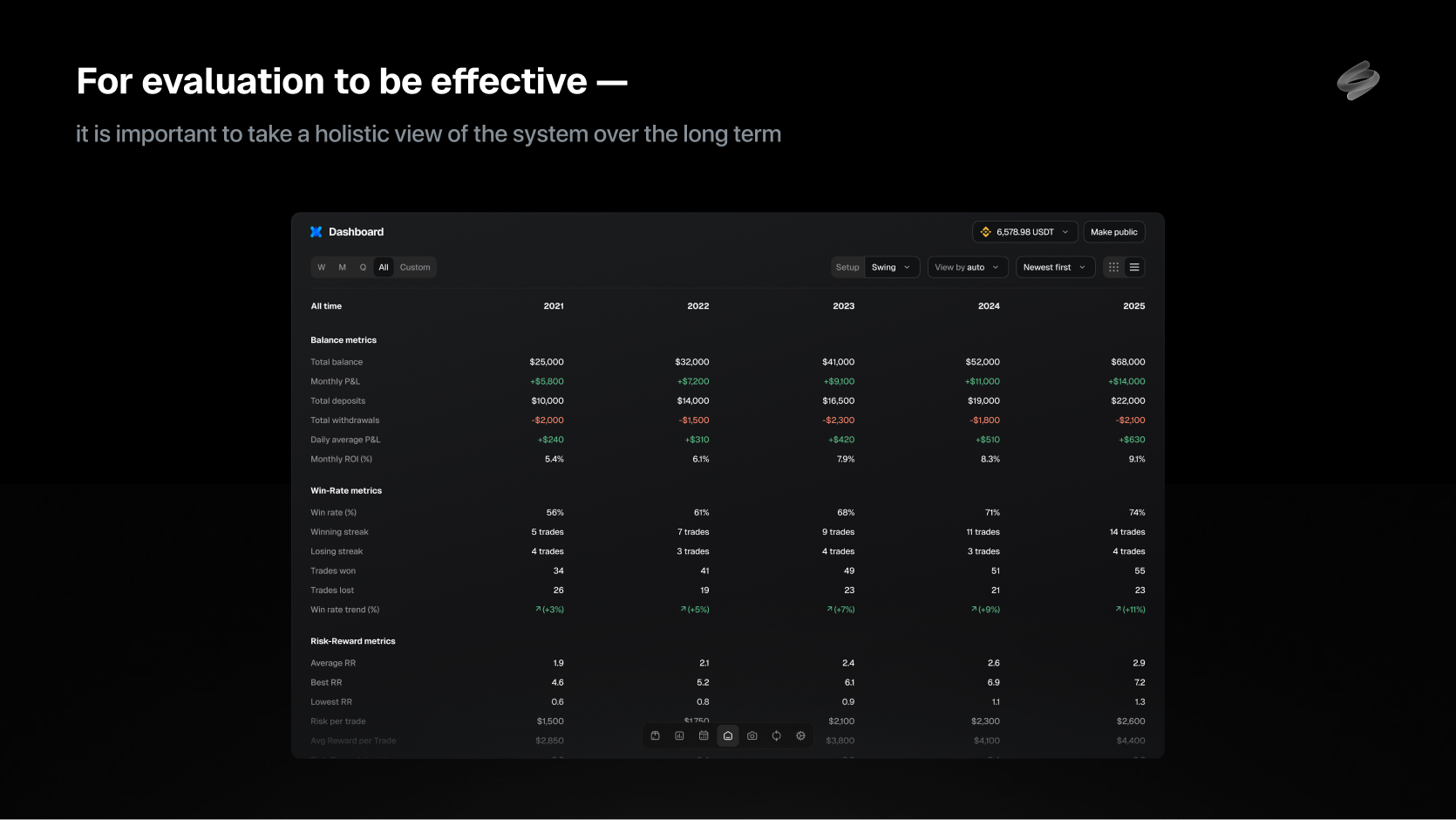
Analyze Trading Expectancy With Scope360°
Calculating trading expectancy manually becomes more difficult as the number of trades, setups and performance variables increases.
Scope360° automatically organizes the trading metrics needed for a more complete analysis, including win rate, average RR, breakeven trades, drawdown, losing streaks and setup performance.
Instead of evaluating a strategy through isolated statistics, traders can compare expectancy across different periods, instruments and trading models.
ScopeAI can then help interpret the relationships between those metrics, making it easier to identify whether changes in performance come from trade selection, risk management, execution or market conditions.
The value of a trading journal is not simply that it stores past trades. Its real purpose is to reveal which parts of the process create an edge and which parts gradually remove it.